
ARTIGO DE PESQUISA
Morpho-physiological studies on in vitro germination of Berberis empetrifolia Lam. (Berberidaceae)
https://doi.org/10.32712/2446-4775.2023.1545
- Castro, Tatiana Carvalho de1
 https://orcid.org/0000-0003-0554-6873
 - Santos, Danúsia da Silva1
https://orcid.org/0000-0003-4061-8086 - Simões-Gurgel, Claudia1
https://orcid.org/0000-0001-8358-2568 - Montiel-Eulefi, Enrique2
https://orcid.org/0000-0002-0982-444X - Honorato, Marco Paredes2
https://orcid.org/0000-0003-3538-6954 - Albarello, Norma1*
https://orcid.org/0000-0001-5803-2070 - 1Universidade do Estado do Rio de Janeiro (UERJ), Instituto de Biologia Roberto Alcantara Gomes (IBRAG), Laboratório de Biotecnologia de Plantas (Labplan), Rua São Francisco Xavier, 524, PHLC, Maracanã, CEP 20550-013, Rio de Janeiro, Brazil.
- 2Universidad de La Frontera (UFRO), Facultad de Medicina, Departamento de Ciencias Básicas, Claro Solar, 180, Temuco, Chile.
- *Correspondência:
- albarellon@gmail.com
Abstract
Berberis empetrifolia is an endemic species from Chile that produces some bioactive compounds, highlighting the alkaloid berberine, which demonstrated antitumor properties. Taking into account the constant plant supply demand required for medicinal use, the establishment of in vitro propagation protocols allows plant multiplication, without affecting natural populations. Moreover, the in vitro germination is an efficient strategy to obtain axenic plants. The aim of this study was to establish the in vitro germination and to characterize seeds morphology and seedling development of B. empetrifolia. After decontamination of seeds, pre-germinative treatments were applied. The seed viability ranged from 75-90% and the embedding curve revealed permeable integument. The germination was characterized as epigeal phanerocotylar type. Seeds not submitted to pre-germinative treatments reached 10-30% germination rate (GR) and showed asynchronous germination. The most efficient pre-germinative treatment was the storage of seeds at 3˚C for 12 days followed by overnight soaking in GA3 solution associated to seed coat removal. This treatment allowed the seed dormancy to be overcome, reaching GR above 95% and resulting in synchronous germination. The in vitro germination protocol established for B.empetrifolia was efficient to produce phenotypically normal axenic seedlings, allowing their use as source of plant material for biotechnological, phytochemical and pharmacological studies.
- Keywords:
- Dormancy.
- Gibberellic acid.
- Medicinal plant.
- Post-seminal development.
- Pre-germinative treatments.
Abbreviations
TTC - 2,3,5-triphenyl tetrazolium chloride; WPM - Wood Plant medium; WPM½ - WPM medium with half salt concentration; GA3 - gibberellic acid; GR - germination rate; GT - mean germination time; CVG - coefficient of velocity of germination; RF - relative frequency of germination.
Introduction
The family Berberidaceae is composed of approximately 14 genera and 700 species of perennial herbs and shrubs. The genus Berberis has attracted interest due to its bioactive substances as alkaloids, steroids, glycosides, flavonoids, saponins, terpenoids and reducing sugars. Root extracts of some species contain quinine, a potent anti-malarial agent[1].
The species of genus Berberis present a broad spectrum of pharmacological activities as antitumor, cardiovascular protection, anti-hyperglycemic, antipyretic, anti-viral, antimicrobial, hepatoprotective, anti-inflammatory, antioxidant, anti-amoebic, anti-allergic, immune-modulator[1,2].
Berberis empetrifolia Lam. (Berberidaceae), known as uva de la cordillera, zarcilla or monte negro, is a sub-shrub perennial, endemic of the Andes (Argentina and Chile). Hermaphroditic flowers occurring in individual or in small umbels, of bright yellow color. Its fruits are dark purple sub-globular berries, containing 3 - 7 seeds. The plants had been used in the Mapuche culture as an infusion for treatment of various diseases, such as fever, inflammation, stomach pains and colitis[3,4]. The B. empetrifolia medicinal properties are mainly attributed to alkaloids, highlighting the berberine, an isoquinoline alkaloid, found in roots, barks and rhizomes, used in Ayurvedic and traditional Chinese medicine, as well as in homeopathic drugs. The berberine has antitumor properties, with effects on human's malignant brain tumor, esophageal cancer and leukemia and colon cancer cell lines[5].
Taking into account the constant plant supply demand required for the medicinal use of B. empetrifolia and for pharmacological and phytochemical studies with the species, the establishment of in vitro propagation protocols allows massal plant multiplication, without impacting natural populations. Moreover, in vitro cultures can also be used for continuous and homogeneous production of bioactive compounds. Therefore, the establishment of in vitro germination is considered the first step to achieve an efficient in vitro propagation protocol, since the seedlings can be used as source of young and axenic plant material[6].
The germination process may be affected by environmental and internal seed factors and, frequently, ideal conditions are species-specific and need to be determined through experimentation[6].Some species have a long germination period because of the dormancy, which consists in a protection to natural conditions. To ensure successful perpetuation of the species, the seeds will germinate in the most favorable environmental conditions for seedling development[7].
The seeds of B. empetrifolia have showed a low germination percentage under field conditions. Studies conducted by Celedón-Neghmeet al.[8] considered the presence of dormancy in the species. Seeds dormancy can be imposed by the embryo, the envelopes (seed coat, endosperm), or a combination of both factors. Seeds dormancy may also occur due to the presence of germination inhibitors, which can be removed by leaching and/or partial removal of the seed husk on the side of the root protrusion[9].
The present study characterizes both seeds morphology and post seminal development of B. empetrifolia and evaluate the use of pre-germinative treatments to overcome dormancy in order to establish the in vitro germination, allowing the supply of plant material for biotechnological, phytochemical and pharmacological studies.
Material and Methods
Plant material
Plants of B.empetrifolia were collected in Trakura, 20 km from Icalma, Cautín province, La Araucania Region, Chile (38° 50' 52.1" S, 71° 29' 15.5" W), 1298 m altitude, between the months of January and March. The taxonomic identification was conducted by the botanist Rubén Carrillo, from the Facultad de Ciencias Agropecuarias y Forestales of the Universidad de La Frontera. Exsiccate was deposited in the Herbarium of the Facultad de Ciencias Agropecuarias y Forestales of the Universidad de La Frontera (UFRO-Be301).
The fruits were transported at 6˚C in the dark. They were washed with distilled water and decontaminated with 75% ethanol. The seeds were manually extracted from the fruits, rinsed with sterile distilled water, dried and conditioned in zip lock plastic bags with hermetic closure and maintained at room temperature. The seeds were sent to the Laboratório de Biotecnologia de Plantas (Labplan/UERJ) for analysis.
Morphological and biometric characterization of seeds
The physical characteristics, such as the length, width and thickness of the seeds were measured with an analogical pachymeter (Mitutoyo 200mm 0,05mm mod.530-321). The morphological description of seeds was carried out using a stereomicroscope (Nikon SMZ745T), following the terminology described in Barroso et al.[10].
Evaluation of seeds viability and coat permeability
Seed viability was assessed by topographical tetrazolium test[11]. Seeds were preconditioning in distilled water at room temperature for 24 h. Then, they were cut longitudinally, immersed in 1% (w/v) of 2,3,5 - triphenyl tetrazolium chloride solution (TTC) for 24 h at 30˚C, in the dark. After this period, the seeds were rinsed with distilled water and observed under the stereomicroscope to determine the location and the staining intensity of embryos. The results were expressed as percentage of viable seeds.
To evaluate the integument permeability seeds were immersing in distilled water for 48 h at 26 ± 1˚C. The seed fresh weight was measured at regular time intervals and data were plotted to establish the imbibition curve.
In vitro germination
Seeds were soaked with 10% neutral detergent for 5min, and rinsed in running tap water. Then, they were decontaminated with 2% NaOCl (sodium hypochlorite) solution plus Tween 80 (0.05% v/v) for 20 min, and rinsed three times in sterile distilled water. The seeds were inoculated in test tubes containing 10 mL of WPM medium[12] with half-salt concentration (WPM½) added with 3% sucrose. The pH was adjusted to 5.8 and the medium solidified with 0.8% agar (Merck) before autoclaving (121˚C for 15 min). The tubes were closed with double aluminum foil caps and maintained in a growth chamber at 26 ± 1˚C, photoperiod of 16 h with light intensity of 50 mmol m-2s-1.
Pre-germinative treatments
Seeds were subjected to the following treatments: mechanical scarification with sandpaper (n˚ 120); storage at 3˚C for 5, 10 or 15 days; storage at 3˚C under immersion in 50μM solution of gibberellic acid (GA3) for 7 days; storage at 3˚C for 12 or 15 days followed by overnight soaking in 50μM GA3 followed or not by seed coat removal; storage at 3˚C for 12 days followed by removal of the seed coat; removes only the seed coat. After pre-germinative treatments, seeds were decontaminated, inoculated under in vitro conditions and maintained in a growth chamber as described above.
The post-seminal development was monitored daily to determine the following parameters[13]: germination rate (GR), mean germination time (GT), coefficient of velocity of germination (CVG) and relative frequency of germination (RF), defined as:
Germination rate: GR (%) = 
where: N = total number of germinated seeds; A = total number of seeds;
Mean germination time: GT (days) = 
where: ni = total number of germinated seeds per day; ti = incubation time (days); Σni= total number of germinated seeds.
Coefficient of velocity of germination: CVG (days-1) = 
Relative frequency of germination related to the incubation time: RF (%) = 
Seedlings were considered normal when essential structures were perfectly developed[11].
Statistical analysis
Each treatment was repeated three times with 20 seeds per replication. Data were submitted to analysis of variance (ANOVA) and the means were compared by Tukey test 5% level of significance. The statistical analysis was performed using the GraphPad Prism 5 statistical software package.
Results and Discussion
Morphological and biometric characterization of seeds
The seeds have dark brown color, smooth testa (seed coat), reniform shape, length 3.7 ± 0.3 mm, width 1.7 ± 0.2 mm and thickness 1.5 ± 0.3 mm (FIGURE 1a) and fresh weight of 4.65 ± 0.83 mg. The embryo is straight, having almost the full length of the seed and the fleshy endosperm (FIGURE 1b).
Evaluation of seed viability and seed coat permeability
According to the TTC test, 75 to 90% of the seeds were viable (FIGURE 1c). This value is higher than the results obtained by Celedón-Neghme et al.[8], evaluating seeds of B. empetrifolia collected in Valle Nevado area, Andes of Central Chile, at 2600m altitude.
The imbibition curve (FIGURE 2) showed a marked increase in fresh weight during the first 4 hours of immersion in distilled water, followed by stabilization after this period, indicating high seed-coat permeability.
In vitro germination
The decontamination of seeds was efficiently performed by immersion in 2% NaOCl solution for 20 min, achieving a minimum contamination after in vitro inoculation (up to 15%). This decontamination protocol was selected because it has already been successfully used with other species studied in Labplan/UERJ[6] and the efficacy of seed decontamination was observed. Moreover, the seedlings of B. empetrifolia developed on WPM½ medium showed normal phenotypical aspect (FIGURE 1d-h). The WPM basic culture medium was selected for our experiments due to the positive results for in vitro germination of B. chitria Lindl.[14]. The authors observed a higher germination percentage in WPM (78.89%) when compared to Murashigue and Skoog (MS) medium (50%), which has been the most used culture medium in in vitro studies. In addition, seeds germinated faster in WPM (± 6 days after inoculation) when compared to MS (± 15 days after inoculation). Positive results using the WPM medium were also found in the in vitro germination of other woody species[15,16].
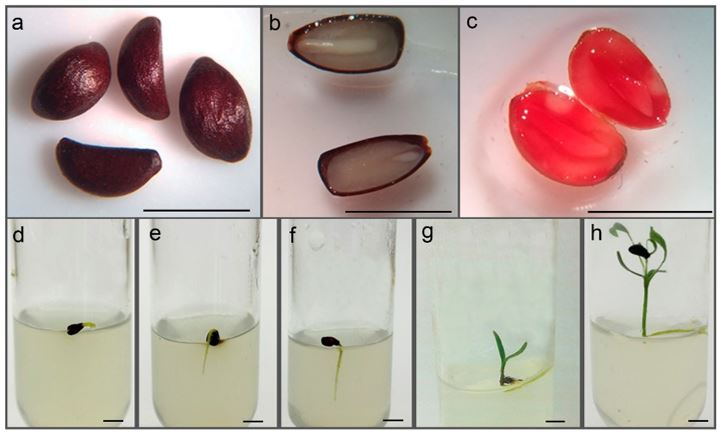

The description of post-seminal development was carried out for the first time for the species. This aspect is very important once the characterization of the first stages of plant development allows the differentiation between species and provides information on natural regeneration, management and conservation. The germination of B. empetrifolia seeds was characterized as epigeal phanerocotylar type. Integral rupture and root protrusion occurred between 30 and 60 days after sowing (FIGURE 1d). Primary root is axial with positive geotropism. About seven days after germination, the primary root was about 1.0 cm in length, color is greenish-yellow, thick, smooth surfaced and it is cylindrical (FIGURE 1e). About ten days after germination (FIGURE 1f), the hypocotyl appears characterized by a curvature in relation to the root and the thickening of the axis delimiting the root portion. Then, the radicle emerges from the seed and on the 15th day the hypocotyl elongates in epigeal germination and releases the cotyledons from the integument (FIGURE 1g). Cotyledons are elliptic, opposite, persistent, thin and green, measuring about 0.8 cm long and 0.2 cm wide. The base of the cotyledon does not taper to a petiole-like structure. After 20 days (FIGURE 1h), the hypocotyl and primary root were elongated, and at least one pair of narrow leaves from the cotyledonary node. The petioles were long, measuring about 1 cm, and the limbus was 0.5 cm long and 0.2 cm wide approximately. At about 30 days, the seedling was complete, with developed epicotyl, containing leaves petiolate, narrow, linear, whole, slightly twisted at the tips, with rounded edges. The presence of secondary roots is observed in this period. Cotyledons remain on the seedling until the end of the observation period.
Previous studies developed by Celedón-Neghmeet et al.[8] evaluating the endozoochoric dispersion of B. empetrifolia seeds, demonstrated that the germination percentage of the species, without any pre-germinative treatment, reached only 5%, after 60 days. This low germination percentage, without synchronism, was also observed in the present study. Seeds not submitted to any pre-germinative treatment showed asynchronous germination, reaching GR between 10% and 30%, with root protrusion observed between 30 and 120 days after inoculation, characterizing the presence of dormancy in these seeds.
Seed dormancy is a genetic characteristic, strongly influenced by the environment, during seed development. Seed dormancy varies between species due to the wide variety of climates, resulting in different classes and levels of dormancy[17]. Considering the dormancy classification, an extensive system was developed by Nikolaeva and Vorobèva[18], who divided endogenous dormancy (embryo dormancy) into: physiological, morphological and morphophysiological; and exogenous dormancy (dormancy imposed by the envelopes) in: mechanical (mechanical resistance), physical (water impermeability) and chemical (presence of chemical inhibitors in extra-seminal tissues)[19]. However, a more recent proposal by Baskin and Baskin[20] considers combined dormancy, which associates physical and physiological dormancy.
Pre-germinative treatments
In order to increase the germination percentage and achieve a more synchronous germination process, different pre-germinative treatments were used. TABLE 1 describes the effect of these treatments under the germination parameters.
Mechanical scarification with sandpaper resulted in low germination percentage (GR = 23.67%), but with a high mean germination time (GT = 57.33days) (TABLE 1). The distribution of the polygon of relative frequency showed the heterogeneity of the germination (FIGURE 3). Celedón-Neghme et al.[8] verified that the germination percentage of B. empetrifolia lizard-ingested seeds presents significant difference in relation to control. The values reach 14% after about 60 days of sowing, compared to 5% for control group over the same period. Moreover, the germination of seeds ingested by lizards began in the first week after sowing, while control seeds germinated after the sixth week. The mechanical and/or chemical action of the lizard digestive tract promotes the removal of the outer layers of the seed coat by thinning the cuticle and palisade sclerenchyma, as observed in the histological cuts, allowing the entry of water necessary for the development of the embryo. However, the authors concluded that this mechanical and/or chemical scarification did not positively affect the germination percentage, which remained low. These results corroborate the present study, in which the mechanical scarification with sandpaper did not increase the germination rate. In addition, the imbibition curve of the seeds (FIGURE 2) indicated full permeability of the integument to water, confirming that there is no physical dormancy in the species.
The use of pretreatment with abscisic acid (ABA) imbibition alone was not effective in the present study for B. empetrifolia (GR = 7.50% e 12.0%) (TABLE 1). On the other hand, for seeds of B. aristate DC an increase in germination rate was observed when seeds were soaked in 50 µM gibberellin (GA3) for six hours, reaching a maximum frequency of 70.4%[21]. The plant phytohormones ABA and gibberellins (GA) are involved in several plant mechanisms like dormancy and germination. ABA is involved in dormancy induction during seed development and GA is involved in germination promotion by inducing cell wall hydrolases, which cause endosperm weakening and embryonic growth. This ABA/GA hormonal balance regulates the maintenance or termination of dormancy and the promotion of germination[7].
The storage pre-treatments at 3˚C for different times with or without soaking in GA3 solution were not effective for breaking the dormancy of B. empetrifolia seeds (GR = 5.50% to GR = 23.33%) (TABLE 1) (FIGURE 3). However, seeds of other species of Berberidaceae have dormancy overcoming after pre-germinative treatment of stratification followed by soaking in GA3. Jeffersonia dubia (Maxim.) Benth. & Hook. F. ex Baker & S. Moore has the morpho-physiological dormancy broken using hot stratification (25/15˚C or 25˚C for 8 weeks) followed by cold stratification (5˚C for 8 weeks) or treatment with 1000 mg.L-1 GA3 followed by incubation at 15/6˚C[22]. Moreover, moist cold stratification is often used to break dormancy and promote subsequent germination of different species. Cold stratification is associated with increased GA content and a decline in ABA content[23]. Additionally, a lower degree of physiological dormancy can be overcome with weeks or months of storage in dry conditions[24].
| Pre-treatments | GR (%) | GT (days) | CVG (days-1) |
|---|---|---|---|
| Mechanical scarification with sandpaper | 23.67±3.84d | 57.33±1.45bc | 0.0175±0.0004b |
| Storage at 3˚C for 5 days | 23.33±6.00d | 83.00±6.24c | 0.0120±0.0002b |
| Storage at 3˚C for 10 days | 12.00±3.05d | 62.67±1.45bc | 0.0160±0.0004b |
| Storage at 3˚C for 15 days | 11.67±1.20d | 62.33±1.45bc | 0.0160±0.0004b |
| Overnight soak in GA3 solution | 7.50±0.29d | 25.33±2.60a | 0.0400±0.0041ab |
| Storage at 3˚C for 7 days under immersion in GA3 solution | 12.00±2.31d | 75.33±2.91c | 0.0133±0.0005b |
| Storage at 3˚C for 12 days followed by overnight soak in GA3 solution | 8.67±0.67d | 49.33±5.81b | 0.0208±0.0024b |
| Storage at 3˚C for 15 days followed by overnight soak in GA3 solution | 5.50±0.29d | 50.00±5.77b | 0.0205±0.0024b |
| Removes only the seed coat | 60.00±2.89c | 16.33±2.03a | 0.0631±0.0078a |
| Storage at 3˚C for 12 days followed removal of the seed coat | 56.00±9.45c | 29.67±4.91a | 0.0358±0.0063ab |
| Overnight soak in GA3 solution followed by seed coat removal | 77.98±1.52b | 37.00±3.61a | 0.0276±0.0029ab |
| Storage at 3˚C for 5 days followed by overnight soak in GA3 solution and seed coat removal | 77.33±4.67b | 25.33±3.84a | 0,0411±0.0054ab |
| Storage at 3˚C for 12 days followed by overnight soak in GA3 solution and seed coat removal | 95.33±2.91a | 34.33±4.33a | 0.0300±0.0034ab |
| Storage at 3˚C for 15 days followed by overnight soak in GA3 solution and seed coat removal | 94.67±2.91a | 23.33±3.30a | 0.0444±0.0055a |
| Mean ± standard error in columns followed by the same letter do not differ by Tukey test (p ≤ 0.05). GA3 - Gibberellic acid(50μM) | |||

In many species, seed coating prevents germination by interfering with water uptake, restricting oxygen diffusion primarily at higher temperatures, imposing mechanical restrictions, containing chemical inhibitors, and modifying the light that reaches the embryo[25]. Seeds that have integuments that act as physical barriers to embryo expansion often contain non-dormant embryos, which germinate easily after integument removal[26]. Seed coat of Fraxinus species proved to be a more influence factor that the high ABA concentration in the embryonic axis, since the removal of the coat allowed the embryo to grow[18]. Manual removal of seed coat from Prunus cerasoides D. Don[27], P. yedoensis Matsum[26] and mango varieties[28], also promoted increased and accelerated the germination process.
The presence of inhibitors in the integument is also a possibility associated to dormancy. Germination inhibitors may be present in the seed envelope, characterizing a chemical dormancy, as well as these inhibitors may be present in the embryo, characterizing a physiological dormancy. However, some authors have considered as physiological dormancy all dormancy caused by the presence of growth inhibitors[19]. Many inhibitors are water soluble and must be leached, while others must be degraded for germination promotion to occur. Chemical inhibition of seed coat can be reversed by the use of exogenous growth promoters such as gibberellins, as well as the removal of the integument [29,30].
The most efficient pre-germinative treatment applied to B. empetrifolia seeds under in vitro conditions were the storage at 3˚C for 12 days followed by overnight soaking in GA3 solution (50μM) associated to seed coat removal. This treatment resulted in a significant increase in the parameters evaluated (TABLE 1), as well as it promoted a more synchronous germination process (FIGURE 3). These results showed that the removal of the B. empetrifolia seeds integument was fundamental for the germination process. Possibly the integument acts as a physical barrier to embryonic expansion, characterizing a mechanical dormancy. Moreover, B. empetrifolia seeds germination mechanical and physiological dormancy aspects were observed, as low-temperature pretreatment and GA3 imbibition associated with tegument removal significantly increased the germination percentage, when compared to the removal of the integument alone (TABLE 1). These features indicate the combined dormancy in the species.
Conclusion
In conclusion, this study describes an efficient protocol to in vitro germination of B. empetrifolia and demonstrates that the process is optimized with the use of pre-germinative treatments. The establishment of axenic and vigorous seedlings is the first step for in vitro cultivation of the species, aiming at mass production of plants and metabolites under in vitro conditions, for future phytochemical and pharmacological studies and, consequently, without harvesting natural populations.
Financing Source
This work was supported by the Brazilian Council for Scientific and Technological Development (CNPq) and The Carlos Chagas Filho Research Support Foundation (FAPERJ).
Conflict of Interests
The authors declare that the research was conducted in the absence of any commercial or financial relationships that could be construed as a potential conflict of interest.
Acknowledgment
The authors are grateful to Ivan Gonçalves Ribeiro (Qualitec/UERJ), Aline Medeiros Saavedra de Paula (Proatec/UERJ) and Adriana Maria Lanziotti (TCT/UERJ) for the valuable technical assistance. It is part of the project "Producción in vitro y evaluación del potencial medicinal de Berberis empetrifolia Lam. (Berberidaceae), una especie nativa de Chile", carried out under the Bilateral Cooperation Grant FAPERJ/Universidad de la Frontera, Chile.
Contributors
Study design: TCC; CS-G; NA
Data curation: TCC; DSS
Data collect: TCC; CS-G; NA
Data analysis: EM-E; MPH
Writing of the original manuscript: EM-E; MPH
Proofreading and Editing: TCC; DSS; CS-G; EM-E; MPH; NA.
References
1. Khan I, Najeebullah S, Ali M, Shinwari ZK. Phytopharmacological and ethnomedicinal uses of the Genus Berberis (Berberidaceae): a review. Trop J Pharmac Res. 2016; 15(9): 2047-2057. [https://doi.org/10.4314/tjpr.v15i9.33].
2. Srivastava S, Srivastava M, Misra A, Pandey G, Rawat AKS. A review on biological and chemical diversity in Berberis (Berberidaceae). EXCLI J. 2015; 14: 247-267. [http://dx.doi.org/10.17179/excli2014-399] [https://pubmed.ncbi.nlm.nih.gov/26535033/].
3. Muñoz MO, Montes M, Wilkomirsky T. Plantas medicinales de uso en Chile: química y farmacología. 2ª edición. Santiago, Chile: Universidad de Chile. Vicerrectoría de Asuntos Académicos:Universitaria. 2004. 330p.
4. Silva F. Flora agropecuaria de Aysén. Ministerio de Agricultura de Chile. Servicio Agrícola y Ganadero Región de Aysén. 2010. 520p.
5. Singh R, Kumari P, Kumar S. Nanotechnology for enhanced bioactivity of bioactive phytomolecules. Nutr Deliv. 2017; 1(1): 413-456. [https://doi.org/10.1016/b978-0-12-804304-2.00011-1].
6. Castro TC, Simões-Gurgel C, Ribeiro IG, Coelho MGP, Albarello N. Morphological aspects of fruits, seeds, seedlings and in vivo and in vitro germination of species of the genus Cleome. J Seed Sci. 2014; 36(3): 326-335. [https://doi.org/10.1590/2317-1545v36n31013].
7. Baskin JM, Baskin CC. A Classification System for Seed Dormancy. Seed Sci Res. 14(1): 1-16. 2004. [https://doi.org/10.1079/SSR2003150].
8. Celedón-Neghme C, San Martin LA, Victoriano PF, Cavieres LA. Legitimate seed dispersal by lizards in an alpine habitat: The case of Berberis empetrifolia (Berberidaceae) dispersed by Liolaemus belii (Tropiduridae). Acta Oecologica. 33(1): 265-271. 2008. [https://doi.org/10.1016/j.actao.2007.11.006].
9. Silva ML, Chagas EA, Villaça R, Smiderle OJ, Moura EA, Chagas PC. Osmopriming duration in Araçá-boi seeds germination. Rev Agro@amb. 2016; 10(1): 17-21. [https://doi.org/10.18227/1982-8470ragro.v10i1.2808].
10. Barroso GM, Amorim MP, Peixoto AL, Ichaso CLF. Frutos e sementes. Morfologia aplicada à sistemática de dicotiledonôneas. Viçosa, MG: UFV. 2004. 444p.
11. Brasil. Brasília: Ministério da Agricultura, Pecuária e Abastecimento. Regras para Análise de Sementes. SDA/MAPA/ACS. 2009. 399p.
12. Lloyd G, Mccown B. Commercially-feasible micropropagation of mountain laurel, Kalmia latifolia, by use of shoot-tip culture. Proceedings of the International Plant Propagators' Society.1981; 30: 421-427.
13. Labouriau LGA. Germinação das Sementes. Washington: Secretaria-Geral da Organização dos Estados Americanos. 1983. 174p.
14. Pandey A, Brijwal L, Tamta S. In vitro propagation and phytochemical assessment of Berberis chitria: An important medicinal shrub of Kumaun Himalaya, India. J Medic Pl Res. 2013; 7(15): 930-937. [https://doi.org/10.5897/JMPR13.4435].
15. Ribeiro MNO, Pasqual M, Villa F, Pio LAS, Hilhorst HWM. In vitro seed germination and seedling development of Annona crassiflora Mart. Sci Agricol. 2009;66(3): 410-413. [https://doi.org/10.1590/S0103-90162009000300017].
16. Li H, Zhang D. In vitro seed germination of Kalmia latifolia L. hybrids: a means for improving germination and speeding up breeding cycle. Hortscience. 2018; 53(4): 535–540. [https://doi.org/10.21273/HORTSCI12829-17].
17. Graeber K, Nakabayashi K, Miatton E, Leubner-Metzger G, Soppe WJJ. Molecular mechanisms of seed dormancy. Pl Cell Environment. 2012; 35(10): 1769-1786. [https://doi.org/10.1111/j.1365-3040.2012.02542.x].
18. Nikolaeva MG, Vorobèva NS. The role of abscisic acid and indolic compoundsin dormancy of the seeds of ash species. Soviet Pl Physiol (USA).1979; 26(12): 105-113. ISSN 0038-5719.
19. Baskin CC, Baskin JM. Seeds. Ecology, biogeography, and evolution of dormancy and germination. 1sted. San Diego: Academic Press. 2001. 666p.
20. Baskin CC, Baskin JM. Seeds: Ecology, biogeography, and evolution of dormancy and germination. 2nd ed. Kentucky, USA. 2014. 1601p.
21. Brijwal L, Pandey A, Tamta S. In vitro propagation of the endangered species Berberis aristata DC. via leaf-derived callus. In Vitro Cellular Develop Biol– Plant. 2015; 51(6):637-647. [https://doi.org/10.1007/s11627-015-9716-7].
22. Rhie YH, Lee SY, Kim KS. Seed dormancy and germination in Jeffersonia dubia (Berberidaceae) as affected by temperature and gibberellic acid. Plant Biology 2014;17: 327-334. [https://doi.org/10.1111/plb.12235].
23. Yamauchi Y, Ogawa M, Kuwahara A, Hanada A, Kamiya Y, Yamaguchi S. Activation of gibberellin biosynthesis and response pathways by low temperature during imbibition of Arabidopsis thaliana seeds. Plant Cell. 2004; 16(2): 367-378. [https://doi.org/10.1105/tpc.018143].
24. Bazin J, Batlla D, Dussert S, El-Maarouf-Bouteau H, Bailly C. Role of relative humidity, temperature, and water status in dormancy alleviation of sunflower seeds during dry after-ripening. J Experim Bot. 2011; 62(2): 627-640. [https://doi.org/10.1093/jxb/erq314].
25. Bewley JD, Black M. Seeds. Physiology, development and germination.2nd edition. New York, Plenum Press. 1994. 445p. [https://doi.org/10.1007/978-1-4899-1002-8].
26. Kim DH. Practical methods for rapid seed germination from seed coat-imposed dormancy of Prunus yedoensis. Scientia Horticulturae. 2019; 243: 451-456. [https://doi.org/10.1016/j.scienta.2018.08.039].
27. Tewari B, Tewari A. Seed germination in Prunus cerasoides influenced by natural seed desiccation and varying temperature in Central Himalayan region of Uttarakhand, India. Inter J Bioassays. 2016; 5(5): 4567-4572. [https://doi.org/10.21746/ijbio.2016.05.007].
28. Muralidhara BM, Reddy YTN, Srilatha V, Akshitha HJ. Effect of seed coat removal treatments on seed germination and seedling attributes in mango varieties. Inter J Fruit Sci. 2016; 16(1): 1-9. [https://doi.org/10.1080/15538362.2015.1021885].
29. Chen S, Kuo S, Chien C. Roles of gibberellins and abscisic acid in dormancy and germination of red bayberry (Myrica rubra) seeds. Tree Physiol. 2008; 28(9): 1431-1439. [https://doi.org/10.1093/treephys/28.9.1431].
30. Webster RE, Waterworth W.M, Stuppy W, West CE, Ennos R, Bray CM, Pritchard HW. Biomechanical, biochemical, and morphological mechanisms of heat shock-mediated germination in Carica papaya seed. J Experim Bot. 2016;67(22): 6373-6384. [https://doi.org/10.1093/jxb/erw402].