 Spasmolytic and antidiarrheal effects of leaves and stem bark extracts from Cenostigma pyramidale (Fabaceae)
Abstract
Cenostigma pyramidale (“catingueira” or ‘‘pau-de-rato’’) is widely used in Brazilian folk medicine to treat various illnesses, including diarrhea. This study aimed to evaluate the in vitro spasmolytic and in vivo antidiarrheal activities of the leaf and stem bark extracts of Cenostigma pyramidale and correlate them with traditional medicine. In the isolated guinea pig ileum, the trichloromethane fraction from the stem bark extract showed concentration-dependent spasmolytic activity in preparations pre-contracted with KCl 40 mM [logCE50 = 1,690 ± 0,09625 µg/mL]. In mice, stem bark extract at doses of 250 or 500 mg/kg reduced total stool mass, while leaf and stem bark extracts reduced intestinal transit at 250, 500, or 750 mg/kg, and 750 mg/kg of leaf extract reduced intestinal fluid accumulation. In conclusion, the antidiarrheal effect of Cenostigma pyramidale may be related to the inhibition of smooth muscle contraction, probably due to the presence of tannins and flavonoids in the extracts.
Keywords smooth muscle; diarrhea; ileum; gastrointestinal transit; biological products
Introduction
Cenostigma pyramidale (Tul.) E. Gagnon & G.P. Lewis (Fabaceae) is a popularly known species as “catingueira”, “catinga-de-porco”, “catingueira-verdadeira”, or “pau-de-rato” found in the Caatinga vegetation from Brazil, and it is used in folk medicine to treat infections, diarrhea, abdominal pain and inflammation[1]. C. pyramidale extracts are rich in flavonoids and phenolic compounds, such as gallic acid, and exhibit neuroprotective, antinociceptive, and anti-inflammatory effects[2]. Previously, this species was classified as Caesalpinia pyramidalis [Tul.] and after Poincianella pyramidalis [Tul.] L.P. Queiroz, but Gagnon et al.[3] stated that this species belongs to the genus Cenostigma, called Cenostigma pyramidale.
Thus, this study aimed to evaluate the in vitro spasmolytic and in vivo antidiarrheal activities of the leaf (CPL) and stem bark (CPB) extracts from C. pyramidale and to correlate the pharmacological findings with the traditional use of this medicinal plant.
Material and Methods
Reagents and drugs
The reference chemicals used in the experiments were potassium chloride (KCl, Aphatec, Brazil) and Cremophor EL®, provided by Sigma-Aldrich (St. Louis, MO, USA); Castor oil was obtained from Riedel-de-Hein® (Seelze, Germany), activated charcoal was provided by Proquimios (Rio de Janeiro, Brazil), and atropine was obtained from Farmace (Barbalha, Brazil). Stock solutions of these chemicals were prepared using suitable solvents, and dilutions were freshly prepared on the day of the experiment. Krebs solution used in organ bath assays was made in distilled water and chemicals used were of the purity grade standard.
Animals
Male rats (280-450 g) and guinea pigs of either sex (350-500 g) used in experimental models were bred and housed in the animal house of Universidade Federal do Vale do São Francisco. All assays were approved by the Animal and Human Ethics Commission of the Universidade Federal do Vale do São Francisco (protocol no. 0005/120514). Before the experiments, all animals were kept under controlled ventilation and temperature (22±1°C) with a 12 h light/dark cycle daily. Mice had free access to water and food until 30 min before the experiments, and guinea pigs were fasted for 16-24 hours before the experiments but with water ad libitum.
Plant material and phytochemical screening of the crude ethanolic extract
The crude ethanolic extract from C. pyramidale was obtained and analyzed previously, and voucher specimens were deposited under the number 21490 at the Universidade Federal do Vale do São Francisco Herbarium, SISGEN Registration nº AA96976. Briefly, C. pyramidale was collected in August 2012 in Riachão do Jacuípe, Bahia, Brazil (12º11′45′′ S latitude and 38º58′05′′ W longitude, Google Earth v.6.0.3.2197), leaves were separated from the stem and air-dried at room temperature.
The dried and pulverized leaves and stem bark were subjected to exhaustive maceration with 95% ethanol to obtain equivalent extracts of CPL and CPB, respectively. From CPL-crude and CPB-crude, hexane (CPL-Hex and CPB-Hex), trichloromethane (CPL-TCM and CPB-TCM), and ethyl acetate (CPL-EtOAc and CPB- EtOAc) phases were obtained.
The phytochemical screening was performed by TLC (thin layer chromatography) were investigated: flavonoids, saponins, mono and diterpenes, triterpenes and steroids, mono and sesquiterpenes, coumarins, anthracenes, anthraquinones, naphthoquinones, and lignans, were utilized systems and revealers adequate for each class of compounds[4].
The solvent was evaporated to obtain the extracts, which were subjected to in vitro pharmacological tests. The crude ethanolic extract was used for in vivo studies.
Preparation of isolated guinea-pig ileum
After fasting, the guinea pigs were euthanized by cervical dislocation, and the ileum was dissected, cleaned, and divided into 1.0 cm segments (tonic contractions). The ileum longitudinal segments were suspended individually using cotton threads in a 10 mL organ bath at 37°C containing modified Krebs' solution (NaCl 117 mM, KCl 4.7 mM, MgSO4.7H2O 1.3 mM, CaCl2·2H2O 2.5 mM, NaH2PO4.H2O, 1.2 mM NaHCO3, 25.0 mM, glucose 11.0 mM) and aerated with a carbogenic mixture. Tissue segments were stabilized with a resting tension of 1.0 g for 45 min (tonic contractions), and the modified Krebs' solution was changed every 15 min. Contractions were recorded using an isometric transducer coupled to a data acquisition system (WinDaq, DATAQ Instruments, Inc., Akron, Ohio, USA).
After the stabilization period, two sets of experiments were performed separately: 1) tissues were stimulated with KCl 40 mM to obtain two similar contractile responses, and after the response to the latter tonic contraction was stabilized, CPL or CPB was cumulatively added (1 to 729 μg/mL) to obtain concentration-response curves, with relaxation measured as the reduction of KCl tone.
Normal intestinal transit in rats
The effects of CPL or CPB on normal intestinal transit were assessed as previously described[5,6]. Rats were randomly separated into groups of six animals and administered the following substances orally: vehicle (10 mL/kg, negative control), CPL or CPB (250, 500, and 750 mg/kg), or atropine (2 mg/kg, positive control). After 30 min, each animal received 1 mL of a 5% charcoal suspension in 2% Arabic gum diluted in distilled water. After 30 min of charcoal administration, each mouse was euthanized, the abdominal cavity was opened, and the gastrointestinal tract was removed to measure the distance traveled by the charcoal from the pylorus to the cecum and the total length of the small intestine. The results were expressed as a percentage of intestinal transit using the formula [% Travelled distance = (total intestinal length - distance traveled by the charcoal) / total intestinal length × 100] and compared to the negative control group.
Castor oil-induced diarrhea in rats
Experimental diarrhea was induced using castor oil, as previously described[7,5]. Before the experiment, 30 rats were fasted for 24 h and divided into groups of six animals. They were treated with CPL, CPB (250, 500, or 750 mg/kg), atropine (2 mg/kg, positive control), or vehicle (10 mL/kg, negative control) via enteral administration. After one hour, castor oil (10 mL/kg) was administered, and the mice were housed individually in an acrylic cage with their surfaces covered with blotting white paper that was changed every hour. Thereafter, the animals were observed for 4h, and the total number of feces excreted was scored as 0: absence of feces; 1, wet feces; 2, liquid or pasty feces in small amounts; or 3, liquid or pasty stools in bulk. The antidiarrheal effect of CPL or CPB was determined by the sum of the scores of either group and compared with that of the negative control group.
Castor oil-induced enteropooling in rats
The experimental procedure was performed according to the literature[8,5] with slight modifications. Thirty rats were fasted for 24 hours and randomly separated into 5 groups of Six animals were used: mice treated with CPL or CPB (250, 500, or 750 mg/kg), rats administered the vehicle (10 mL/kg, negative control), normal animals that received the vehicle (10 mL/kg), and were not administered castor oil (positive control). All the solutions were administered orally. Thirty minutes later, castor oil (10 mL/kg) was administered, and after another 30 min, the rats were euthanized by cervical dislocation, the abdomen was opened, the whole small intestine was isolated, and the intestinal contents were poured into a 5 mL measuring cylinder.
Statistical analysis
Data are presented as mean ± SEM; the concentration required to obtain a half-maximum response (EC50) was calculated by nonlinear curve fitting and expressed as mean ± 95% confidence interval. Results were analyzed by one-way analysis of variance (ANOVA) followed by Dunnet post-test for multiple comparisons or Student’s t-test, and differences were considered significant at p<0.05. Statistical analyses were performed using Prism 8.0 software (GraphPad Software Inc., San Diego, CA, USA).
Results and Discussion
Phytochemical analysis of CPL and CPB revealed the presence of anthracene, flavonoids, tannins, lignans, saponins, and naphthoquinone classes (TABLE 1). Some studies have reported the presence of polyphenols, flavonoids, and tannins in the leaves and stem barks of P. pyramidalis[9-11]. A plant of the same botanical synonymy, Caesalpinia bonducella L., also popularly indicated for gastrointestinal problems, promoted an antidiarrheal effect, which was suggested to be related to the compounds found in the plant, such as tannins, alkaloids, flavonoids, saponins, sterols, and/or terpenoids present in the plant[12].
Previously, Ribeiro et al.[13] and Diniz et al.[14] showed that stem bark extract from C. pyramiladis protected stomach against ethanol were duced gastric damage, but intestinal effects of this species was not evaluated.
This study indicates, for the first time, the pharmacological effects of the leaves and stem bark of C. pyramidale in animal models of intestinal motility and diarrhea, which is one of the main uses of this medicinal plant. Initially, partitioned crude extracts and their fractions were assayed in isolated guinea pig ileum, as shown in FIGURE 1. In ileal preparations pre-contracted with KCl, the fractions from CPL had a lower maximum effect (Emax) than those from CPB (FIGURE 1A-B). Moreover, there was no significant difference between the crude CPL and the CPL fractions (FIGURE 1C). However, the trichloromethane fraction from CPB (logCE50 = 1.690 ± 0.09625 µg/mL) was significantly more potent than the crude CPB (2.312 ± 0.1320 µg/mL), as shown in FIGURE 1D. High potassium levels in smooth muscle can induce phasic and tonic contractions, mainly by increasing the opening of voltage-operated calcium channels, promoting their influx, and activating their contractile proteins[15]. Therefore, CPB may promote ileal relaxation by modifying Ca2 signaling.
In rats subjected to castor oil-induced diarrhea models, there was no reduction in the fecal mass of animals treated with CPL compared to the negative control group (FIGURE 2-AD).
In contrast, the animals treated with 250 or 500 mg/kg CPB showed a reduction in fecal mass at 60 min, 0.416 ± 0.3546 g, and 0.606 ± 0.606 g, respectively, when compared with animals that received vehicle (5.365 ± 1.618 g), as shown in FIGURE 3A, but this effect disappeared at 120, 180, and 240 min (FIGURE 3B-D).
However, when the number of feces produced by the animals was analyzed, there was no difference between the groups that received CPL or CPB and the animals that received the vehicle (FIGURE 4A-B).
: Effect of Cenostigma pyramidale leaf and bark extracts on the number of defecations in rats.
In rats subjected to castor oil-induced enteropooling, only 750 mg/kg CPL (1.62 ± 0.42 mL) significantly reduced luminal fluid secretion compared to animals that received the vehicle (3.4 ± 0.5 mL), as shown in FIGURE 5A.
Castor oil has a laxative effect through the intestinal production of ricinoleic acid, which induces diarrhea by increasing muscle motility, fluid secretion, and signal transduction pathways involving prostanoid receptors and the nitric oxide pathway[16,17].
Therefore, extracts from C. pyramidale contain secondary metabolites that may act on these pathways to reduce diarrhea and watery secretions in the intestines of rats.
In the normal intestinal transit model, both CPL and CPB reduced the travel of luminal activated charcoal compared to vehicle (FIGURE 6). For 250, 500, and 750 mg/kg CPL, the percentage inhibition values were 43.26 ± 3.715, 52.08 ± 3.103, and 50.56 ± 3.934, respectively. For 250, 500, and 750 mg/kg of CPB, the percentage of inhibition values were 43.61 ± 6.552, 47.05 ± 5.392, and 62.10 ± 13.38%, respectively.
: Effect of Cenostigma pyramidale leaf and bark extracts on normal intestinal transit in rats.
Normal intestinal transit has several local mechanisms through the enteric nervous system that regulate the tone of smooth muscle in the propulsion of the fecal bolus, which is an important route for the investigation of drugs for the treatment of gastrointestinal disorders[18].
Conclusion
Taken together, these results suggest that C. pyramidale extracts exert significant intestinal effects, reducing fecal excretion and fluid secretion, probably owing to intestinal smooth muscle relaxation, and validate their use as medicinal plants for treating diarrhea. However, additional studies are necessary to isolate the metabolites from the extracts responsible for spasmolytic and antidiarrheal effects.
Acknowledgments
The authors would like to thank the government agencies CAPES, CNPq and FACEPE for their financial support, and UNIVASF for the physical structure provided.
References
- 1 Sousa LMS, Santos BNG, Medeiros MDGF, Lima IBC, Santos-Filho FS, Santana ACSGV, et al. Poincianella pyramidalis (Tul) L.P. Queiroz: A review on traditional uses, phytochemistry and biological-pharmacological activities. J Ethnopharmacol. 2021; 264: 113181. ISSN: 0378-8741. [acesso em: 11 jul. 2024]. Available: [ https://doi.org/10.1016/j.jep.2020.113181 ].
» https://doi.org/10.1016/j.jep.2020.113181 - 2 Souza CS, Grangeiro MS, Pereira EPL, Santos CC, Silva AB, Sampaio GP, et al. Agathisflavone, a flavonoid derived from Poincianella pyramidalis (Tul.), enhances neuronal population and protects against glutamate excitotoxicity. Neurotoxicology. 2018; 65: 85-97. [acesso em: 11 jul. 2024]. Available: [ https://doi.org/10.1016/j.neuro.2018.02.001 ].
» https://doi.org/10.1016/j.neuro.2018.02.001 - 3 Gagnon E, Bruneau A, Hughes CE, De Queiroz LP, Lewis GP. A new generic system for the pantropical Caesalpinia group (Leguminosae). PhytoKeys 2016; 71: 1-160. [acesso em: 11 jul. 2024]. Available:https://doi.org/10.3897/phytokeys.71.9203].
» https://doi.org/10.3897/phytokeys.71.9203 - 4 Harborne AJ. Phytochemical methods are a guide to modern techniques of plant analysis. 3 th ed. Springer science & Business media. 1998. ISBN-0412572605.
- 5 Giliani AU, Ghayur MN, Khalid A, Zaheer-ul-Haq, Choudhary MI, Atta-ur-Rahman. Presence of antispasmodic, antidiarrheal, antisecretory, calcium antagonist and acetylcholinesterase inhibitory steroidal alkaloids in Sarcococca saligna. Pl Med. 2005; 71:120-125. [acesso em: 20 ago. 2024]. Available: [ https://doi.org/10.1055/s-2005-837777 ].
» https://doi.org/10.1055/s-2005-837777 - 6 Rao VS, Santos FA, Sobreira TT, Souza MF, Melo CL, Silveira ER. Investigations on the gastroprotective and antidiarrhoeal properties of ternatin, a tetramethoxyflavone from Egletes viscosa. Pl Med. 1997; 63:146-149. [acesso em: 20 ago. 2024]. Available: [ https://doi.org/10.1055/s-2006-957632 ].
» https://doi.org/10.1055/s-2006-957632 - 7 Borrelli F, Capasso F, Capasso R, Ascione V, Aviello G, Longo R, Izzo AA. Effect of Boswellia serrata on intestinal motility in rodents: inhibition of diarrhoea without constipation. 2006. Br J Pharmacol. 148:553-560. [acesso em: 20 ago. 2024]. Available: [ https://doi.org/10.1038/sj.bjp.0706740 ].
» https://doi.org/10.1038/sj.bjp.0706740 - 8 Di Carlo G, Autore G, Izzo AA, Maiolino P, Mascolo N, Viola P, et al. Inhibition of intestinal motility and secretion by flavonoids in mice and rats: structure-activity relationships. J Pharm Pharmacol. 1993; 45: 1054-1059. [acesso em: 20 ago. 2024]. Available: [ https://doi.org/10.1111/j.2042-7158.1993.tb07180.x ].
» https://doi.org/10.1111/j.2042-7158.1993.tb07180.x - 9 Bahia MV, Santos JB dos, David JP, David JM. Biflavonoids and other phenolics from Caesalpinia pyramidalis (Fabaceae). J Braz Chem Soc. 2005; 16(6b): 1402-5. [acesso em: 11 jul. 2024]. Available: [ https://doi.org/10.1590/S0103-50532005000800017 ].
» https://doi.org/10.1590/S0103-50532005000800017 - 10 Melo JG, Araújo TAS, Castro VTNA, Cabral DLV, Rodrigues MD, et al. Antiproliferative activity, antioxidant capacity and tannin content in plants of semi-arid northeastern Brazil. Molecules. 2010; 15(12): 8534-42. [acesso em: 11 jul. 2024]. Available: [ https://doi.org/10.3390/molecules15128534 ].
» https://doi.org/10.3390/molecules15128534 - 11 Moraes SZDC, Shan AYKV, Melo MAO, Silva JP, Passos FRS, Souza AG, et al. Antinociceptive and anti-inflammatory effect of Poincianella pyramidalis (Tul.) LP Queiroz. J Ethnopharmacol. 2020; 254: 112563. [acesso em: 11 jul. 2024]. Available: [ https://doi.org/10.1016/j.jep.2020.112563 ].
» https://doi.org/10.1016/j.jep.2020.112563 - 12 Billah MM, Islam R, Khatun H, Parvin S, Islam E, Islam SA, et al. Antibacterial, antidiarrhoeal, and cytotoxic activities of methanol extract and its fractions of Caesalpinia bonducella (L.) Roxb leaves. BMC Complement Altern Med. 2013; 13:101. [acesso em: 11 jul. 2024]. Available: [ https://doi.org/10.1186/1472-6882-13-101 ].
» https://doi.org/10.1186/1472-6882-13-101 - 13 Ribeiro AR, Diniz PB, Estevam CS, Pinheiro MS, Albuquerque-Júnior RL, Thomazzi SM. Gastroprotective activity of the ethanol extract from the inner bark of Caesalpinia pyramidalis in rats. J Ethnopharmacol. 2013; 147(2): 383-8. [acesso em: 11 jul. 2024]. Available: [ https://doi.org/10.1016/j.jep.2013.03.023 ].
» https://doi.org/10.1016/j.jep.2013.03.023 - 14 Diniz PB, Ribeiro AR, Estevam CS, Bani CC, Thomazzi SM. Possible mechanisms of action of Caesalpinia pyramidalis in ethanol-induced gastric damage. J Ethnopharmacol. 2015; 168: 79-86. [acesso em: 11 jul. 2024]. Available: [ https://doi.org/10.1016/j.jep.2015.03.054 ].
» https://doi.org/10.1016/j.jep.2015.03.054 - 15 Souza SD, Franca CS, Niculau ES, Costa LC, Pinto JE, Alves PB, et al. Antispasmodic effect of Ocimum selloi essential oil on the guinea-pig ileum. Nat Prod Res. 2015; 29(22): 2125-8. [acesso em: 21 nov. 2024]. Available: [ https://doi.org/10.1080/14786419.2014.989392 ].
» https://doi.org/10.1080/14786419.2014.989392 - 16 Galheigo MR, Prado LC, Mundin AM, Gomes DO, Chang R, Lima AM, et al. Antidiarrhoeic effect of Eugenia dysenterica DC (Myrtaceae) leaf essential oil. Nat Prod Res. 2016; 30(10): 1182-5. [acesso em: 21 nov. 2024]. Available: [ https://doi.org/10.1080/14786419.2015.1043633 ].
» https://doi.org/10.1080/14786419.2015.1043633 - 17 Tunaru S, Althoff TF, Nüsing RM, Diener M, Offermanns S. Castor oil induces laxation and uterus contraction via ricinoleic acid activating prostaglandin EP3 receptors. Proc Natl Acad Sci U S A. 2012; 109(23): 9179-9184. [acesso em: 21 nov. 2024]. Available: [ https://doi.org/10.1073/pnas.1201627109 ].
» https://doi.org/10.1073/pnas.1201627109 - 18 Kumral D, Zfass AM. Gut Movements: A Review of the Physiology of Gastrointestinal Transit. Dig Dis Sci. 2018; 63(10): 2500-2506. [acesso em: 21 nov. 2024]. Available: [ https://doi.org/10.1007/s10620-018-5259-1 ].
» https://doi.org/10.1007/s10620-018-5259-1
-
Funding Source:
This study was partially funded by the Coordenação de Aperfeiçoamento de Nível Superior (CAPES) (Funding Code 001).
Publication Dates
- Publication in this collection
04 Dec 2025 - Date of issue
Dec 2025
History
- Received
11 Mar 2025 - Accepted
05 Nov 2025

 Legend: Effect of leaves and bark extracts of Cenostigma pyramidale (CPL and CPB) and organic phases (CPL-Crude, CPL-Hex, CPL-TCM, CPL-EtOAc and CPB-Crude, CPB-Hex, CPB-TCM, CPB-EtOAc) on tonic contractions in isolated guinea-pig ileum showing a spasmolytic activity. A, Concentration-response curve of CPL (1-729 µg/mL) in preparation pre-contracted with KCl 40 mM. B, Concentration-response curve of CPB (1-729 µg/mL) in preparations pre-contracted with KCl 40 mM. C, Comparison between the potency obtained from the phases obtained from the CPL. D, Comparison between the potency obtained from the CPB phases. Data are expressed as mean ± SEM (n = 5); *p<0,05 obtained by Student’s t-test.
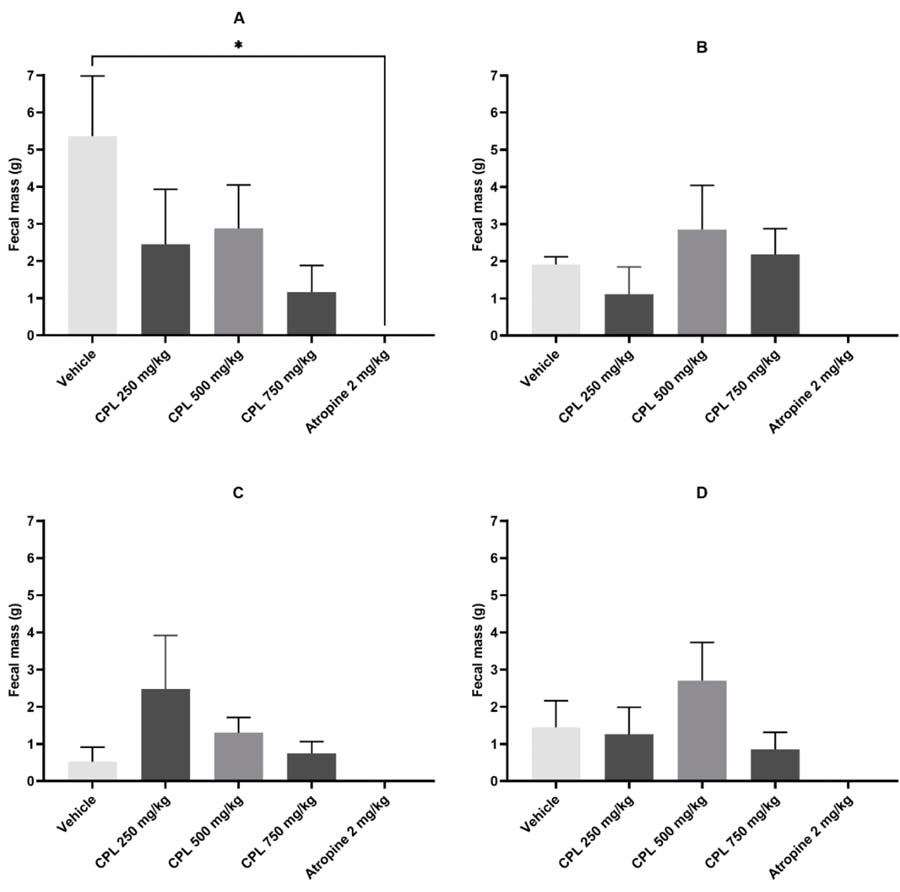 Legend: Effect of Cenostigma pyramidale leaf extract on castor oil-induced diarrhea in rats. Fecal mass of the animals during 4h after the administration of castor oil. A, Fecal mass of animals 60 min after castor oil administration. B Fecal mass of animals 120 min after castor oil administration. C, Fecal mass of animals 180 min after castor oil administration. D, Fecal mass of animals 240 min after castor oil administration. Atropine (2 mg/kg) was used as a positive control (PC), and distilled water with cremophor (3% v/v) was used as a negative control (NC). Data are expressed as mean ± SEM (n = 5); * p<0.05, one-way ANOVA followed by Dunnett’s test.
 Legend: Effect of Cenostigma pyramidale bark extract on castor oil-induced diarrhea in rats. Fecal mass of the animals during 4h after the administration of castor oil. A, Fecal mass of animals 60 min after castor oil administration. B Fecal mass of animals 120 min after castor oil administration. C, Fecal mass of animals 180 min after castor oil administration. D, Fecal mass of animals 240 min after castor oil administration. Atropine (2 mg/kg) was used as a positive control (PC), and distilled water with cremophor (3% v/v) was used as a negative control (NC). Data are expressed as mean ± SEM (n = 5); * p<0.05, one-way ANOVA followed by Dunnett’s test.
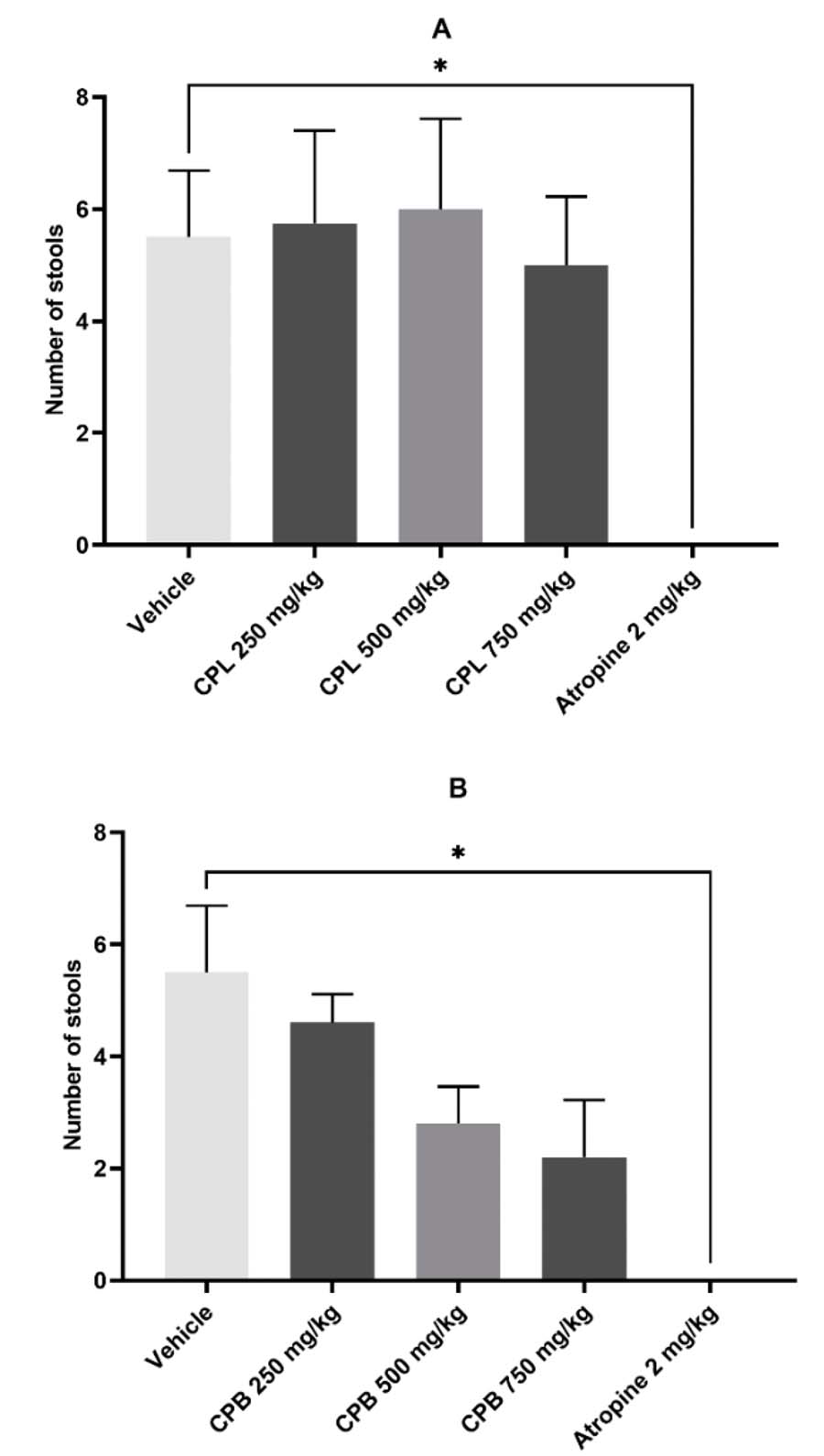 Legend: Effect of Cenostigma pyramidale leaf (A) and bark (B) extracts on the number of defecations in rats. Atropine (2 mg/kg) was used as a positive control (PC), and distilled water with cremophor (3% v/v) was used as a negative control (NC). Data are expressed as mean ± SEM (n = 5); * p<0.05, one-way ANOVA followed by Dunnett’s test.
 Legend: Effect of Cenostigma pyramidale leaf (A) and bark (B) extracts on intestinal fluid accumulation. Atropine (2 mg/kg) was used as a positive control (PC), and distilled water with cremophor (3% v/v) was used as a negative control (NC). Data are expressed as mean ± SEM (n = 5); * p<0.05, one-way ANOVA followed by Dunnett’s test.
 Legend: Effect of Cenostigma pyramidale leaf (A) and bark (B) extracts on normal intestinal transit in rats. Atropine (2 mg/kg) was used as a positive control (PC), and distilled water with cremophor (3% v/v) was used as a negative control (NC). Data are expressed as mean ± SEM (n = 5); * p<0.05, one-way ANOVA followed by Dunnett’s test.