Development and Stability of a Topical Curcuma longa Emulsion for Veterinary Use in Hyperimmune Serum Horses
Abstract
Horses used for hyperimmune serum production frequently develop local inflammatory reactions at injection sites. The dry extract of Curcuma longa L. (DECL) exhibits anti-inflammatory and wound-healing properties; however, its topical veterinary use requires pharmaceutical standardization. In this study, a 3% DECL oil-in-water emulsion was developed and its physicochemical, microbiological, and stability characteristics were evaluated using a validated HPLC method for total curcuminoids. Diethylene glycol monoethyl ether was selected as a pre-solvent based on solvent-screening assays. DECL-loaded and blank emulsions were prepared using a mixed nonionic emulsifying system and evaluated at 0, 30, and 90 days under room (25 ± 2°C) and accelerated (45 ± 2°C) conditions. The formulations remained homogeneous, with no phase separation or precipitation, and showed pH values compatible with equine skin, with only a slight decrease over time. Total curcuminoid content remained stable under both storage conditions. The HPLC-DAD method demonstrated adequate selectivity, linearity, accuracy, and precision according to regulatory guidelines. Microbiological analyses confirmed the absence of contamination. Overall, the 3% DECL emulsion met essential pharmaceutical quality attributes and maintained stability for 90 days, supporting its potential as a standardized topical herbal medicinal product for veterinary use in horses.
Curcuma longa L.; Emulsion; Turmeric extract; Curcumin; Curcuminoids; Horses
Introduction
Skin problems are common in horses and have been widely reported in the literature, often associated with sports practice, vehicle traction, or exposure to environmental conditions, facilities, and pastures. The active behavior and quick reactions of horses predispose them to frequent skin injuries, whose healing process is known to be slower compared to other species. In addition, horses subjected to immunization protocols for the production of hyperimmune serum are particularly vulnerable, as they may develop local inflammatory reactions at the antigen inoculation site, characterized by edema, abscesses, and fistulas[1]. These adverse effects are often related to the use of adjuvants, such as Freund’s incomplete adjuvant (FIA), Freund’s complete adjuvant (FCA), and Montanide®[2]. Consequently, the World Health Organization (WHO) recommends the implementation of alternative protocols that minimize potential harm to horses undergoing immunization procedures[3].
In this context, medicinal plants have been increasingly investigated for their anti-inflammatory, analgesic, and wound-healing properties, as well as for their ability to inhibit or mitigate toxic effects of snake venoms. Among them, Curcuma longa L. (Zingiberaceae) stands out due to its wide spectrum of pharmacological activities, including antioxidant and anti-inflammatory[4], antimicrobial[5], antifungal, antiviral[6], and wound-healing effects[7]. These biological activities are primarily attributed to curcuminoids (polyphenols) present in the rhizomes: curcumin, desmethoxycurcumin, and bisdesmethoxycurcumin[8,9]. Ethnoveterinary studies reinforce these findings, reporting the traditional use of C. longa in horses, either added to feed for arthritis and joint pain or applied directly to hooves and skin lesions[10].
Despite these promising biological effects, the clinical application of C. longa extracts and their main active compound, curcumin, remains limited due to challenges related to low bioavailability, solubility, and permeability[11]. To overcome these issues, several strategies have been investigated, including nanotechnology-based delivery systems such as nanogels, nanoemulsions, nanosuspensions, and lipid carriers[12,13]. However, conventional pharmaceutical systems such as emulsions also represent a promising and more feasible approach, given their ability to enhance solubilization, stability, and delivery of poorly soluble phytochemicals. An emulsion is a biphasic system in which one immiscible liquid is dispersed into another in the form of fine droplets, allowing solubilization of the active compound either in the dispersed or continuous phase[14].
Emulsions have demonstrated their importance as versatile carriers in pharmaceutical technology and can play a key role in veterinary medicine by improving the therapeutic use of herbal extracts[15]. Our previous study with a 3% C. longa topical emulsion in horses used for antivenom production demonstrated anti-inflammatory, anti-edematous, and wound-healing potential[16]. In the development of herbal medicines, it is critical to conduct tests established in official pharmacopoeias, including evaluations of physicochemical, biological, and microbiological stability, using validated analytical methods in accordance with regulatory requirements such as Resolution RDC Nº. 166/2017 of the Brazilian Health Regulatory Agency (ANVISA)[17]. Thus, the objective of this study was to develop and evaluate the stability of a topical emulsion containing 3% C. longa extract, aiming to provide a safe, stable, and standardized herbal product with potential veterinary application in horses used for hyperimmune serum production.
Results and Discussion
O/W Emulsion Formulation
The development of the oil-in-water (O/W) emulsion aimed to obtain a stable vehicle for incorporating the DECL, a phytocomplex rich in curcuminoids with recognized therapeutic potential. As a preliminary step, a solubility assay was conducted to identify the most suitable solvent for dissolving the extract prior to incorporation into the formulation. Among the tested solvents, DEGEE (105.40 ± 3.84 mg·g⁻1) showed significantly higher solubilizing capacity for curcuminoids compared with propylene glycol (7.13 ± 0.59 mg·g⁻1), yielding approximately 14-fold higher curcuminoid concentrations. These findings are consistent with previous reports highlighting DEGEE as an effective solvent and penetration enhancer for curcumin-based formulations[12]. Importantly, toxicological and biocompatibility studies confirm that this excipient exhibits good dermal tolerability and low irritancy at formulation-level concentrations[18], supporting its safe use in both human and veterinary topical preparations. Based on these results, DEGEE was selected as the diluent to maximize curcuminoid incorporation, enhance reproducibility, and ensure formulation stability.
The qualitative and quantitative composition of the formulations (TABLE 1) was designed to balance physicochemical stability, safety, and compatibility for topical application. The oily phase contained a combination of glyceryl monostearate, cetearyl alcohol, and ceteareth-20, which acted synergistically as emulsifying and stabilizing agents while providing emollience and consistency. Liquid paraffin and 2-ethylhexyl stearate were included to enhance occlusion, spreadability, and sensorial properties of the product. The antimicrobial system consisted of phenoxyethanol combined with parabens, in accordance with regulatory guidelines for cosmetic and dermatological preparations[19].
The aqueous phase was composed of glycerin, acting as both a humectant and solvent, and VP/Ammonium acryloyldimethyltaurate copolymer, a rheology modifier responsible for viscosity control and stabilization of the dispersed system. Purified water served as the continuous phase. Finally, DEGEE (Phase C) was used to solubilize the extract, enabling homogeneous dispersion of the active ingredient within the emulsion.
A total of 1500 g of DECL-loaded emulsion (3%, w/w) and 1500 g of blank were produced and filled into opaque low-density polyethylene (LDPE) containers (50 g capacity, single wall, screw cap) to prevent light-induced degradation. Quality control tests, including physicochemical and microbiological assessments, were carried out after 24 h of preparation, ensuring compliance with pharmacopeial recommendations.
Method validation
The analytical method for the quantification of total curcuminoids in the DECL-loaded emulsion was validated in accordance with ANVISA Resolution RDC nº 166/2017[17]. The validation parameters investigated included selectivity, linearity, accuracy, and precision.
Selectivity
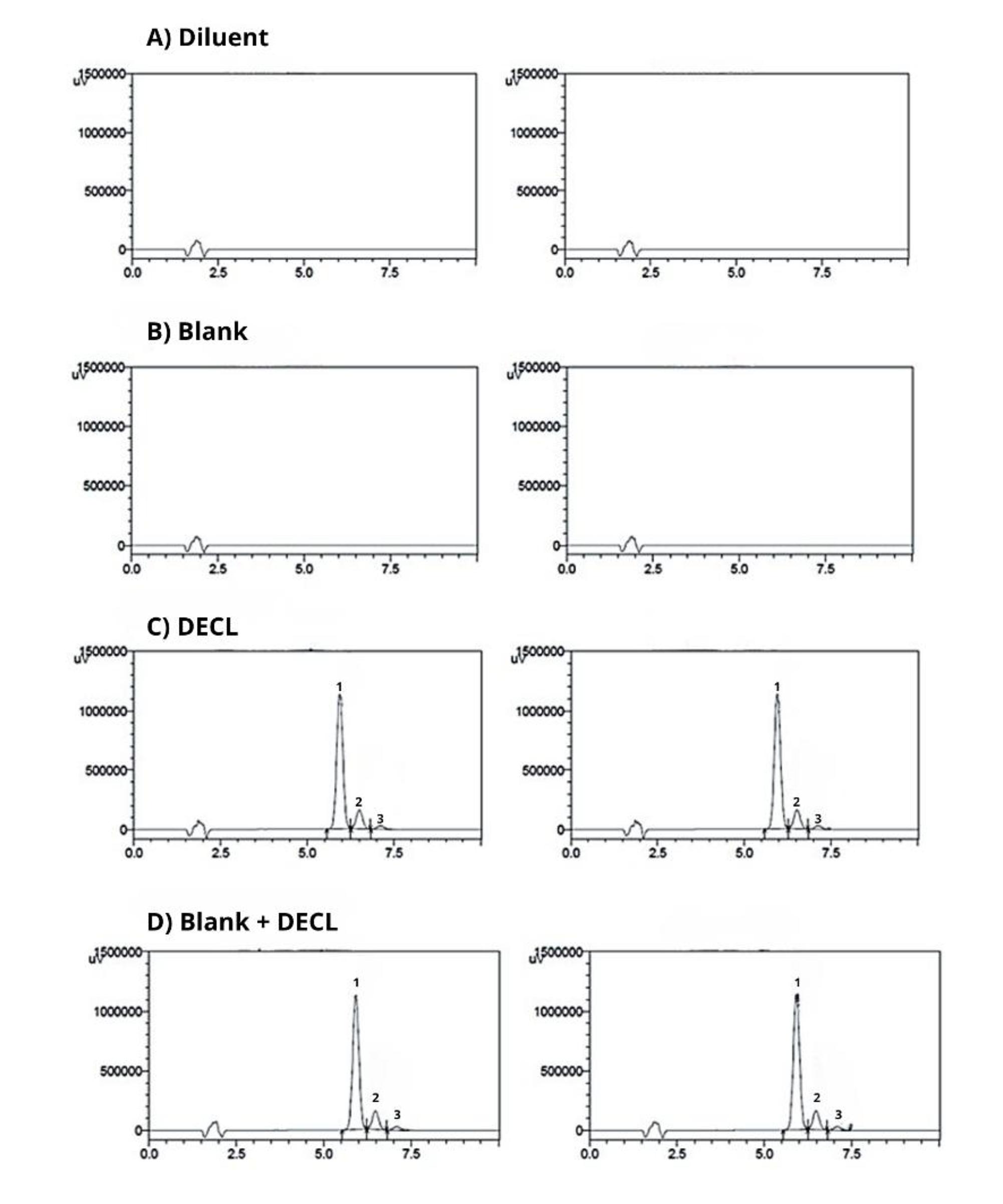
Selectivity refers to the ability of an analytical method to unequivocally assess the analyte of interest in the presence of other components, such as excipients, impurities, or degradation products[17]. In this study, selectivity was evaluated by comparing chromatograms of the diluent, blank, pure DECL, and blank spiked with DECL. No interfering peaks were observed at the retention time of the analytes, confirming the absence of matrix effects. Additionally, peak purity analysis was performed using the diode array detector, with purity index values > 999, indicating no co-elution and confirming that the curcuminoid peaks were spectrally homogeneous (FIGURE 1).
: Chromatograms for selectivity assessment: (A) Diluent; (B) Blank; (C) Pure DECL; (D) Blank spiked with DECL. Peaks 1–3 correspond to curcuminoids (curcumin, demethoxycurcumin, and bisdemethoxycurcumin, respectively).
Linearity
Linearity is defined as the method’s ability to obtain results that are directly proportional to the concentration of the analyte across a specified range[17]. This ensures reliable quantification at different concentration levels. Calibration curves were prepared in the range of 0.16–0.24 mg/mL, with each concentration injected in triplicate. The chromatographic response was calculated from the sum of the individual peak areas of the curcuminoids. Regression analysis showed a correlation coefficient and determination coefficient, both exceeding the acceptance criterion of 0.99. Residual analysis confirmed homoscedasticity (Cochran’s test), normal distribution (Shapiro–Wilk test, p > 0.05), and absence of lack-of-fit by ANOVA, demonstrating that the method provides accurate linear responses (TABLE 2).
Accuracy
Accuracy expresses how close the experimental results are to the true value, and it is usually evaluated by recovery studies with spiked samples. In this work, the blank matrix was fortified with the curcuminoid standard at three levels (80%, 100%, and 120%). Mean recovery values ranged from 99.23% to 103.4%, all within the acceptance range of 95–105%, demonstrating that the method is accurate for total curcuminoid determination in the emulsion matrix (TABLE 3).
: Accuracy (% recovery) and precision (% RSD) of the validated HPLC method for total curcuminoids (n=3).
Precision
Precision measures the degree of agreement between independent analytical results under defined conditions and is expressed as the relative standard deviation (RSD). It is subdivided into repeatability (same analyst, same day) and intermediate precision (different analysts and/or days). Repeatability showed RSD values of 0.92% (Day 1) and 2.20% (Day 2), while intermediate precision, evaluated with 18 determinations across both analysts, resulted in an RSD of 1.77% (TABLE 3). All values were below the 5% acceptance limit, confirming that the method is precise under both repeatability and intermediate precision.
DECL-loaded and Blank Emulsions Physico-Chemical Stability Test
The physical–chemical stability of the 3% DECL-loaded emulsion and its blank was investigated under two storage conditions (25 ± 2°C and 45 ± 2°C) for 90 days. Parameters included macroscopic aspect, pH, phase separation, and total curcuminoid content, and the results are summarized in TABLE 4.
: Results of the accelerated stability tests of DECL-loaded (A) and blank (B) emulsions under different storage conditions and time points.
Macroscopic Aspect and Phase Separation
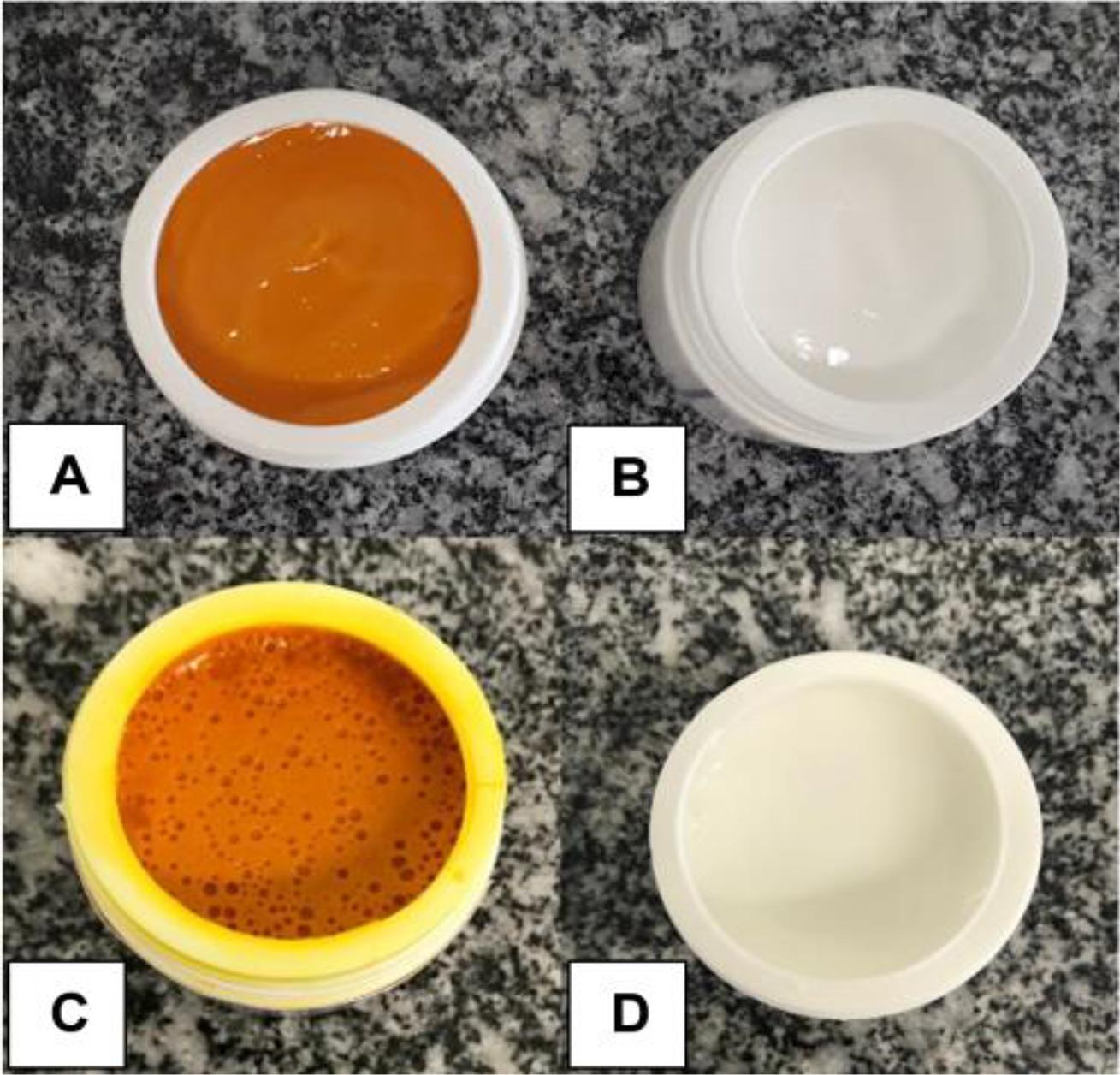
At baseline (T0), both formulations presented homogeneous appearance, with no signs of precipitation and phase separation. The DECL-loaded emulsion was characterized by a bright yellow–orange color and a pungent odor typical of C. longa extract, whereas the blank showed a uniform white and glossy aspect. These findings indicated adequate incorporation of the extract into the system and absence of incompatibility between components. After 90 days at room temperature, no macroscopic alterations were observed for either emulsion, both remaining stable and classified as normal (N).
Under accelerated conditions (45°C), mild modifications were observed: the DECL-loaded emulsion exhibited surface bubbles, possibly due to water evaporation, and the blank showed a more fluid and opaque consistency. However, neither formulation presented phase separation or loss of integrity, and both were classified only as slightly modified (LM). The results are shown in FIGURE 2.
: (A) DECL-loaded emulsion and (B) blank emulsion stored at room temperature (25 ± 2°C); (C) DECL-loaded emulsion and (D) blank emulsion stored at oven temperature (45 ± 2 °C). All samples were stored for 90 days.
pH Evaluation
At T0, the DECL-loaded emulsion had a mean pH of 5.93 ± 0.12 and the placebo 5.31 ± 0.10, values within the physiological range for equine skin (4.8–6.8)[10]. Over storage at 25 °C, a progressive decrease in pH was observed, reaching 5.24 ± 0.04 (DECL-loaded emulsion) and 5.40 ± 0.10 (blank) at T90, with statistically significant differences (p < 0.05). Despite this reduction, no macroscopic or organoleptic alterations were detected. At 45°C, DECL-loaded emulsion pH values decreased further to 4.71 ± 0.05, while the blank remained relatively stable. Importantly, all values remained within the safe range for topical use, ensuring compatibility with skin application and preservative system activity[20]. Such pH decreases, often reported in emulsions containing polyphenols, may reflect slow oxidative or hydrolytic processes in the system, even in the absence of visible instability or loss of active content, and should therefore be monitored as potential early indicators of long-term degradation[21].
Total Curcuminoid Content
Quantification of curcuminoids was performed using a validated HPLC method, in which the total curcuminoid content was calculated from the sum of the individual peak areas of curcumin, demethoxycurcumin, and bisdemethoxycurcumin. This strategy is scientifically justified because these congeners share a common chromophore and exhibit similar UV absorption characteristics, allowing accurate quantification under the same detection wavelength. Moreover, this approach follows established practices in phytopharmaceutical analysis, where the labeled marker is defined as the sum of structurally related constituents. Examples include total hypericins in Hypericum perforatum[22] and total silymarin in Silybum marianum[23].
In the DECL-loaded emulsion, total curcuminoid content remained stable under both storage conditions. At room temperature (25 ± 2°C), values were 3.30% at T0 and remained unchanged at 3.30% after 90 days, despite a slight increase at T30 (3.35%), which may be attributed to analytical variability. Under accelerated storage (45 ± 2°C), total curcuminoid content was also stable, with identical values of 3.50% at both T30 and T90.
These findings demonstrate that the emulsion matrix provided effective protection for the curcuminoids, preventing significant degradation even under elevated temperature conditions.
Microbiological quality and method suitability
Microbiological quality is a key attribute in topical formulations, as contamination or ineffective preservation may compromise both safety and therapeutic performance. In the present study, the microbiological assays were performed according to the Brazilian Pharmacopoeia[24] confirming that both the DECL-loaded and blank emulsions met the requirements for non-sterile topical products.
TAMC, TYMC and microbial recovery assays demonstrated the adequacy of the pharmacopoeial method. All reference microorganisms — A. Brasiliense, C. albicans, P. aeruginosa, S. aureus, and B. subtilis — were successfully recovered within the acceptance limits of 50–200% of the inoculum. The neutralization step by 1:10 dilution proved effective in suppressing preservative interference (phenoxyethanol and parabens) while maintaining the detection capacity of the culture media, thus validating the robustness of the approach for semisolid emulsions.
Although alternative neutralizers such as polysorbate 80 and lecithin are commonly employed for paraben-containing formulations, the Brazilian Pharmacopoeia recognizes dilution as a valid neutralization strategy, particularly for emulsified systems. Comparative studies[25,26] also support this procedure as reliable and reproducible when microbial recovery remains within pharmacopoeial limits, as observed herein.
Challenge tests and microbial detection
The challenge tests further confirmed that the preservative system was effectively neutralized, allowing consistent recovery of S. aureus and P. aeruginosa in both DECL-loaded and blank emulsions. S. aureus colonies exhibited the characteristic yellow pigmentation with halo on MSA, whereas P. aeruginosa produced typical green colonies on CA. Growth was consistently detected at all evaluated time points (T0, T30 under room temperature, and T30 under accelerated conditions), demonstrating that the formulation matrix exerted no inhibitory effects on microbial detection.
Absence of microbial contamination
Routine microbiological quality tests revealed no contamination in either formulation during the entire experimental period. These results confirm that the emulsions complied with microbiological specifications for non-sterile topical products and that manufacturing and handling processes were properly controlled. Similar findings were described by Al-Busaid et al.[27], in curcumin-based topical formulations, reinforcing the safety and microbiological stability of phytopharmaceutical emulsions.
Material and Methods
Materials and Reagents
The dried extract of Curcuma longa L. (DECL) (CJH-A-822542), obtained from rhizomes through hydroethanolic extraction, was purchased from Infinity Pharma® (São Paulo, Brazil) (CAS No. 458-37-7). From the same supplier were also obtained: propylene glycol, cetearyl alcohol, ceteareth, liquid paraffin, phenoxyethanol, parabens, and glycerin. Glyceryl monostearate was acquired from Via Pharma® (São Paulo, Brazil); 2-ethylhexyl stearate from Farmos® (São Paulo, Brazil); diethylene glycol monoethyl ether (DEGEE) from Gattefossé® (Saint-Priest, France); ammonium acryloyldimethyltaurate/VP copolymer from Clariant® (Muttenz, Switzerland); citric acid (≥ 99%); tetrahydrofuran (THF, HPLC grade) and acetonitrile (HPLC grade, LiChrosolv®) all from Merck® (Darmstadt, Germany); and the curcuminoid reference standard SQR (≥ 94% curcuminoids, ≥ 80% curcumin, lot SLBR4883V) from Sigma-Aldrich® (St. Louis, MO, USA). Purified water was obtained using a reverse osmosis system (Gehaka®, São Paulo, Brazil).
For the microbiological assays, the following culture media were used: tryptic soy broth (TSB), tryptic soy agar (TSA), sabouraud dextrose agar (SDA, 4%), mannitol salt agar (MSA), and cetrimide agar (CA) (all from Becton Dickinson, Franklin Lakes, NJ, USA). Reference strains included Staphylococcus aureus ATCC 6538, Pseudomonas aeruginosa ATCC 9027, Bacillus subtilis ATCC 6633, Candida albicans ATCC 10231, and Aspergillus brasiliensis ATCC 16404 (American Type Culture Collection, Manassas, VA, USA). Inoculum preparation employed McFarland standard 0.5 (≈ 1 × 10⁸ CFU/mL; Marcy-l'Étoile, French) and physiological saline solution (0.9% NaCl; Merck®, Darmstadt, Germany).
Solubility assay
The solubility of the DECL was assessed in DEGEE and propylene glycol. Samples (1 g/10 mL) were vortex-mixed, shaken for 48 h at room temperature, and centrifuged at 4000 rpm for 10 min. Supernatants were diluted and analyzed by UV–Vis spectrophotometry at 425 nm (Cary 50, Varian®). Quantification was performed using SQR curcuminoid standard and calibration curves prepared according to USP 43 guidelines[28].
O/W Emulsion Formulation
The O/W emulsion was prepared according to the composition described in TABLE 1. The raw materials were separated into two phases: the oil phase (Phase A), heated to 75 ± 1°C, and the aqueous phase (Phase B), heated to 80 ± 1°C. Once all ingredients of both phases were completely solubilized, the aqueous phase was poured into the oil phase under homogenization (Ultra-T18 basic, IKA®, Staufen, Germany) at 500–1000 rpm for 10 min.
For the preparation of the complementary phase (Phase C), DECL was gradually solubilized in DEGEE under constant stirring at room temperature and subsequently incorporated into the oil phase. The blank (placebo emulsion without the active extract) was prepared following the same procedure but without the addition of Phase C.
Emulsion Physico-Chemical Stability Test
The immediate stability, (T0), of DECL-loaded and blank emulsions was assessed 24h after the preparation, to give the emulsion time to stabilize, for evaluation of the physico-chemical (Macroscopic aspect, pH, phase separation and total curcuminoid content) characteristics.
For long-term stability tests, the formulations were stored under two temperature conditions for 90 days: room temperature (25 ± 2°C) and accelerated storage at 45 ± 2°C in an oven (Model 430, Ethik Technology®, São Paulo, Brazil), according to ANVISA guidelines[29]. Quality control tests, as described above, were performed after 30 (T30) and 90 (T90) days of storage.
Macroscopic aspect
The macroscopic characteristics of A and B emulsions were evaluated under natural light, considering color, odor, and the presence of precipitate or phase separation. The formulations were classified according to the following criteria: normal without changes (N), slightly modified (SM), or intensely modified (IM). Odor evaluation was performed directly by olfactory assessment, following ANVISA guidelines[29,30].
pH Measurements
The pH of the formulations was determined at 25 ± 2.0°C using a digital benchtop potentiometer (Hach Sension 3®, Loveland, CO, USA) equipped with a glass electrode previously calibrated with standard buffer solutions at pH 4.00 and 7.00. The measurements were performed on aqueous dispersions of the samples (1:10, w/w, sample:water). Each determination was carried out in triplicate, and results were expressed as mean ± standard deviation (SD).
Centrifugation Assay
The centrifugal stability of A and B emulsions was evaluated using conical graduated centrifuge tubes containing 3.0 g of each formulation. Samples were centrifuged (CT 4000, Cientec®, São Paulo, Brazil) at 3000 rpm for 30 min at 25 ± 2.0°C. After centrifugation, the samples were visually inspected for signs of phase separation, caking, coalescence, or other instability phenomena, according to ANVISA guidelines[29]. The formulations were classified as normal without changes (N), slightly modified (SM), or intensely modified (IM).
Total Curcuminoid content
The quantification of total curcuminoids in DECL-loaded emulsion was performed using an ultra-high-performance liquid chromatography (UHPLC) system NEXERA (Shimadzu®, Kyoto, Japan) equipped with the following modules: diode array detector (DAD, SPD-M20A Prominence), column oven (CTO-30A), dual pumps (LC-30AD), and autosampler (SIL-30AC). Data acquisition and processing were carried out using LabSolutions software.
Chromatographic separation was achieved on an ACE® C8 column (150 × 4.6 mm i.d., 5 µm particle size; Analítica®, Brazil). The isocratic mobile phase consisted of citric acid solution (1 mg·mL⁻1), tetrahydrofuran (THF), and acetonitrile in a ratio of 57:40:03 (v/v/v), with a flow rate of 1.2 mL/min, column temperature of 30°C, and injection volume of 10 µL. Detection was carried out at 420 nm. The chromatographic conditions were adapted from the United States Pharmacopeia[28] for curcuminoid analysis.
For sample preparation, approximately 320 mg of DECL-loaded emulsion or blank were accurately weighed and transferred into a 50 mL volumetric flask. About 40 mL of acetonitrile were added, and the mixture was sonicated for 1 min to achieve complete solubilization. The volume was then adjusted with the same solvent, homogenized, and filtered through a regenerated cellulose (RC) membrane filter (0.45 µm) into vials for injection. Each sample was injected in duplicate, and the quantification was performed by substituting the values of the summed peak areas of curcuminoids into the linear regression equation obtained from the calibration curve (linearity assay), in order to determine the total curcuminoid content.
Method validation
The analytical method for total curcuminoid content was validated according to the parameters established by ANVISA Resolution RDC nº 166/2017[17], including selectivity, linearity and range, accuracy, and precision (repeatability and intermediate precision).
Selectivity was evaluated by UHPLC analysis of diluent, blank, pure DECL, and fortified blank solutions. The acceptance criterion was the absence of interference from the diluent, blank, or any excipient at the retention time of the curcuminoids. All analyses were performed after appropriate sample preparation and filtration.
Linearity and range were assessed using three independent calibration curves, each constructed with five concentration levels (0.16–0.24 mg/mL). The regression analysis was performed by the least-squares method, and statistical evaluation included correlation coefficients, homoscedasticity (Cochran test), normality of residuals (Shapiro–Wilk test), and lack-of-fit assessment (ANOVA). The method was considered linear when r and r2 values were greater than 0.99 and when the 95% confidence interval of the slope did not include zero.
Accuracy was determined by recovery assays at three levels (80%, 100%, and 120% of nominal concentration, n = 3, each). Results were expressed as percentage recovery compared with the calibration curve obtained from linearity. The acceptance criterion was recovery within 95–105% for all levels.
Precision was evaluated at the same three concentration levels (80%, 100% and 120%) in triplicate. Repeatability was determined by the same analyst on the same day, and intermediate precision was assessed by two different analysts on different days. Precision was considered adequate when the relative standard deviation (RSD) was below 5%.
Microbiological assays
Microbiological quality tests were performed according to the Brazilian Pharmacopoeia, 6th edition[24], which establishes standardized procedures for non-sterile pharmaceutical products. Since the formulations contained preservatives (phenoxyethanol and parabens), all samples were neutralized prior to testing to avoid false-negative results. Both blank and DECL-loaded emulsions were diluted at a 1:10 ratio (w/v) in TSB under constant homogenization to ensure complete dispersion. All analyses were performed in duplicate, and results were expressed as arithmetic means of colony-forming units (CFU) per gram of product.
Method suitability test
The suitability of the pharmacopoeial method was verified by inoculating standardized suspensions of reference strains (Aspergillus brasiliensis, Candida albicans, Pseudomonas aeruginosa, Staphylococcus aureus, and Bacillus subtilis) in the presence and absence of the product. The method was considered adequate when microbial recovery ranged between 50–200% of the initial inoculum compared with the control samples, confirming the absence of preservative interference.
Microbial enumeration tests
Total aerobic microbial count (TAMC) and total yeast and mold count (TYMC) were determined using the plate count method on TSA and SDA, respectively. Plates were incubated under conditions recommended by the Brazilian Pharmacopoeia[24], and results were expressed as CFU/g of product.
Challenge test and controls
Assay reliability was verified using negative, positive, and product controls conducted in parallel. Tests were carried out at baseline (T0), after 30 days at room temperature (T30 – RT), and under accelerated conditions (T30 – oven). For microbial quality testing, the acceptance criterion was the absence of specified pathogens, while for challenge assays, recovery of the inoculated microorganisms was expected, confirming effective neutralization of the preservative system.
Test for specified microorganisms
Specific tests for Staphylococcus aureus and Pseudomonas aeruginosa were performed using MSA and CA, respectively. Plates were incubated at 35 ± 2.5°C for 72h. Absence of growth indicated compliance with microbiological quality requirements, while typical colony morphology confirmed microbial recovery in the challenge assays.
Statistical analysis
Results were expressed as mean ± standard deviation (SD) (n=3). Comparisons among arithmetic means were performed using analysis of variance (ANOVA). A p-value ≤ 0.05 was considered statistically significant.
Conclusion
This study developed and standardized a topical oil-in-water emulsion containing 3% DECL and demonstrated its quality, safety, and stability for potential veterinary use in horses employed for hyperimmune serum production. A targeted solubility screening justified the use of DEGEE as the pre-solubilizing co-solvent, enabling efficient incorporation of curcuminoids into the emulsion. A stability-indicating HPLC method adapted from USP was validated for total curcuminoids (sum of curcumin, demethoxycurcumin, and bisdemethoxycurcumin), meeting regulatory criteria for selectivity, linearity, accuracy, and precision.
Across 90 days at 25 ± 2°C and 45 ± 2°C, the DECL-loaded emulsion showed no phase separation and only minor, acceptable pH decreases that remained within the physiological range for equine skin. Total curcuminoid content remained stable in the emulsion at both temperatures, indicating protective effects of the vehicle on the phytomarkers. Microbiological assessments confirmed method suitability, effective neutralization of preservatives at 1:10 dilution, recovery of challenge organisms, and absence of contamination in DECL and blank formulations.
Together with prior evidence of anti-inflammatory, anti-edematous, and wound-healing actions of C. longa in horses, these data support the DECL emulsion as a promising herbal medicinal candidate. Future work should extend shelf-life studies (6–12 months, photostability and packaging compatibility), characterize rheology and skin permeation in equine skin, perform preservative-effectiveness testing, and conduct controlled clinical evaluations of efficacy and local tolerance under field conditions, alongside scale-up and GMP validation.
Acknowledgments
The authors gratefully acknowledge the Galenic Development Laboratory (LADEG, UFRJ), the Laboratory of Analytical Development and Validation (LDVA, Fiocruz), the Natural Products Laboratory (PN5, Fiocruz), and the Vital Brazil Institute (IVB) for technical and institutional support. The authors also pay tribute to Dr. Benjamin Gilbert (in memoriam) for his invaluable scientific contributions and lasting influence on natural products research.
References
- 1 Angulo Y, Estrada R, Gutiérrez JM. Clinical and laboratory alterations in horses during immunization with snake venoms for the production of polyvalent antivenom. Toxicon. 1997; 35(1): 81-90. [ https://doi.org/10.1016/S0041-0101 (96)00077-3].
» https://doi.org/10.1016/S0041-0101 (96)00077-3 - 2 Waghmare AB , Salvi NC , Deopurkar RL , Shenoy PA , Sonpetkar JM . Evaluation of health status of horses immunized with snake venom and Montanide adjuvants during antivenom production. Toxicon. 2014; 82: 83-92. [ https://doi.org/10.1016/j.toxicon.2014.02.012 ].
» https://doi.org/10.1016/j.toxicon.2014.02.012 - 3 World Health Organization. Guidelines for the production, control and regulation of snake antivenom immunoglobulins. WHO Tech Rep Ser. 2017; 1004: 1-197.
- 4 Chainani-Wu N. Safety and anti-inflammatory activity of curcumin, a component of turmeric ( Curcuma longa ). J Altern Complement Med. 2003; 9(1): 161-168. [ https://doi.org/10.1089/107555303321223035 ].
» https://doi.org/10.1089/107555303321223035 - 5 Punjataewakupt A, Napavichayanun S, Aramwit P. The downside of antimicrobial agents for wound healing. Eur J Clin Microbiol Infect Dis. 2019; 38(1): 39-54. [ https://doi.org/10.1007/s10096-018-3393-5 ].
» https://doi.org/10.1007/s10096-018-3393-5 - 6 Ferreira LLC, Abreu MP, Costa CB, Leda PO, Behrens MD, dos Santos EP. Curcumin and its analogs as a therapeutic strategy in RNA virus infections. Food Environ Virol. 2022; 14(2): 120-137. [ https://doi.org/10.1007/s12560-022-09514-3 ].
» https://doi.org/10.1007/s12560-022-09514-3 - 7 Sidhu GS, Singh AK, Thaloor D, Banaudha KK, Patnaik GK, Srimal RC. Enhancement of wound healing by curcumin in animals. Wound Repair Regen. 1998; 6(2): 167-177. [ https://doi.org/10.1046/j.1524-475x.1998.60211.x ].
» https://doi.org/10.1046/j.1524-475x.1998.60211.x - 8 Panahi Y, Fazlolahzadeh O, Atkin SL, Majeed M, Butler AE, Johnston TP. Evidence of curcumin effects in skin diseases: a narrative review. J Cell Physiol. 2019; 234(2): 1165-1178. [ https://doi.org/10.1002/jcp.27096 ].
» https://doi.org/10.1002/jcp.27096 - 9 Naghetini CC. Caracterização físico-química e atividade antifúngica dos óleos essenciais da cúrcuma. Belo Horizonte: UFMG; 2006.
- 10 Lans C , Turner N , Brauer G , Lourenco G , Georges K . Ethnoveterinary medicines used for horses in Trinidad and British Columbia. J Ethnobiol Ethnomed. 2006; 2: 31. [ https://doi.org/10.1186/1746-4269-2-31 ].
» https://doi.org/10.1186/1746-4269-2-31 - 11 Mohanty C, Das M, Sahoo SK. Emerging role of nanocarriers to increase curcumin bioavailability. Expert Opin Drug Deliv. 2012; 9(11): 1347-1364. [ https://doi.org/10.1517/17425247.2012.724676 ].
» https://doi.org/10.1517/17425247.2012.724676 - 12 Algahtani MS, Ahmad MZ, Nourein IH, Alyami HS, Alyami MH, et al. Curcumin nanoemulgel for wound healing evaluation. Gels. 2021; 7(4): 213. [ https://doi.org/10.3390/gels7040213 ].
» https://doi.org/10.3390/gels7040213 - 13 Ferreira SBS, Bruschi ML. Improving the bioavailability of curcumin: is micro/nanoencapsulation the key? Ther Deliv. 2019; 10(2): 83-86. [ https://doi.org/10.4155/tde-2018-0075 ].
» https://doi.org/10.4155/tde-2018-0075 - 14 Aulton ME. Delineamento de formas farmacêuticas. 4ª ed. Porto Alegre: Artmed; 2016.
- 15 Basto SRL, Ferreira-Silva JC, Silva FLA, Aleixo GAS, Stamford TCM, Silva MV, et al. Emulsão e microemulsão: novos sistemas de liberação controlada. Med Vet (UFRPE). 2016; 10(1-4): 25-33.
- 16 Ferreira LLC , Lopes DCDXP , Oliveira JSP , Oliveira MS , Cunha LER , Behrens MD , et al . Avaliação da eficácia da emulsão tópica de Curcuma longa no tratamento de reações locais em cavalos. Braz J Health Rev. 2024; 7: e68066. [ https://doi.org/10.34119/bjhrv7n2-121 ].
» https://doi.org/10.34119/bjhrv7n2-121 - 17 Brasil. Ministério da Saúde. Agência Nacional de Vigilância Sanitária. Resolução RDC nº 166, de 24 de julho de 2017: validação de métodos analíticos. Brasília: ANVISA; 2017.
- 18 Osborne DW. Diethylene glycol monoethyl ether: An emerging solvent in topical dermatology products. J Cosmet Dermatol. 2011; 10(4): 324-329. [ https://doi.org/10.1111/j.1473-2165.2011.00590.x ].
» https://doi.org/10.1111/j.1473-2165.2011.00590.x - 19 Scientific Committee on Consumer Safety (SCCS). Opinion on phenoxyethanol (CAS 122-99-6), 3% as preservative in cosmetics. SCCS/1575/16. Luxembourg: European Commission; 2016.
- 20 Lukic M, Pantelic I, Savic SD. Towards optimal pH of the skin and topical formulations: From the current state of the art to tailored products. Cosmetics. 2021; 8(3): 69. [ https://doi.org/10.3390/cosmetics8030069 ].
» https://doi.org/10.3390/cosmetics8030069 - 21 Zheng B, McClements DJ. Formulation of more efficacious curcumin delivery systems using colloid science: Enhanced solubility, stability, and bioavailability. Molecules. 2020; 25(12): 2791. [ https://doi.org/10.3390/molecules25122791 ].
» https://doi.org/10.3390/molecules25122791 - 22 Rückert U, Likussar W, Michelitsch A. Simultaneous determination of total hypericin and hyperforin in St. John's wort extracts by HPLC with electrochemical detection. Phytochem Anal. 2007; 18(3): 204-208. [ https://doi.org/10.1002/pca.969 ].
» https://doi.org/10.1002/pca.969 - 23 AbouZid SF , Chen SN , Pauli GF . Silymarin content in Silybum marianum populations growing in Egypt. Ind Crops Prod. 2016; 83: 729-737. [ https://doi.org/10.1016/j.indcrop.2015.12.012 ].
» https://doi.org/10.1016/j.indcrop.2015.12.012 - 24 Brasil. Ministério da Saúde. Agência Nacional de Vigilância Sanitária. Farmacopeia Brasileira. 6ª ed. Brasília: ANVISA; 2019.
- 25 Vasconcelos TYL, Medeiros DPF, Nascimento AA. A inibição do sistema conservante de duas emulsões O/A por polissorbato 80. Infarma Ciênc Farm. 2015; 27(4): 221-225.
- 26 Katerji A, Trefi S, Bitar Y, Ibrahim A. Evaluation of new formulations for neutralizing antimicrobial preservatives in pharmaceutical preparations. Heliyon. 2023; 9(3): e14555. [ https://doi.org/10.1016/j.heliyon.2023.e14555 ].
» https://doi.org/10.1016/j.heliyon.2023.e14555 - 27 Al-Busaid MM, Akhtar MS, Alam T, Shehata WA. Development and evaluation of herbal cream containing curcumin from Curcuma longa. Pharm Pharmacol Int J. 2020; 8(5): 285-289. [ https://doi.org/10.15406/ppij.2020.08.00307 ].
» https://doi.org/10.15406/ppij.2020.08.00307 - 28 United States Pharmacopeia . Curcuminoids. In: USP-NF 43. Rockville (MD): USP; 2021. [ https://doi.org/10.31003/USPNF_M2499_04_01 ].
» https://doi.org/10.31003/USPNF_M2499_04_01 - 29 Brasil. Ministério da Saúde. Agência Nacional de Vigilância Sanitária. Guia de estabilidade de produtos cosméticos. Brasília: ANVISA; 2004.
- 30 Brasil. Ministério da Saúde. Agência Nacional de Vigilância Sanitária. Guia de controle de qualidade de produtos cosméticos. 2ª ed. Brasília: ANVISA; 2008.
-
Abbreviations
DECL – Dry Extract of Curcuma longa L.C. longa – Curcuma longa L.O/W – Oil-in-WaterUHPLC – Ultra-High Performance Liquid ChromatographyHPLC – High Performance Liquid ChromatographyDAD – Diode Array DetectorUV–Vis – Ultraviolet–Visible SpectrophotometryANVISA – Agência Nacional de Vigilância Sanitária (Brasil)WHO – World Health OrganizationUSP – United States PharmacopeiaRH – Relative HumidityLDPE – Low-Density PolyethyleneGMP – Good Manufacturing PracticesDEGEE – Diethylene Glycol Monoethyl EtherTHF – TetrahydrofuranVP – Vinylpyrrolidoneq.s. – Quantum sufficitCAS – Chemical Abstracts ServiceTAMC – Total Aerobic Microbial CountTYMC – Total Yeast and Mold CountCFU – Colony-Forming UnitsTSB – Tryptic Soy BrothTSA – Tryptic Soy AgarSDA – Sabouraud Dextrose AgarMSA – Mannitol Salt AgarCA – Cetrimide AgarATCC – American Type Culture CollectionSD – Standard DeviationRSD – Relative Standard DeviationANOVA – Analysis of Variancer – Correlation coefficientr – Determination coefficientp – p-valueT0 – Initial Time (baseline)T30 – 30 daysT90 – 90 daysRT – Room TemperatureN – NormalLM – Lightly ModifiedSM – Slightly ModifiedIM – Intensely ModifiedNA – Not ApplicableSQR – Secondary Quality ReferenceFCA – Freund’s Complete AdjuvantFIA – Freund’s Incomplete Adjuvant
-
Funding Sources
This study received no specific grant from any funding agency in the public, commercial, or not-for-profit sectors.
Publication Dates
- Publication in this collection
10 Aug 2026 - Date of issue
2026
History
- Received
23 Jan 2026 - Accepted
10 June 2026